The fantasy is irresistible. Wake up when you want. Work from anywhere. Choose your own projects. Make more money than your salaried friends while they sit in meetings about meetings. No commute. No office politics. No asking permission to take a vacation.
Here's the thing: that fantasy can be real. Plenty of developers are living it right now. But the path to get there is wildly different from what most people expect. It's not about being the best coder. It's not about luck. And it's definitely not about signing up for Upwork and waiting for the clients to roll in.
I've watched developers succeed spectacularly at freelancing and I've watched equally talented developers crash and burn. The difference almost never comes down to technical skills. It comes down to understanding that freelancing is a business, and businesses require more than just being good at the core service.
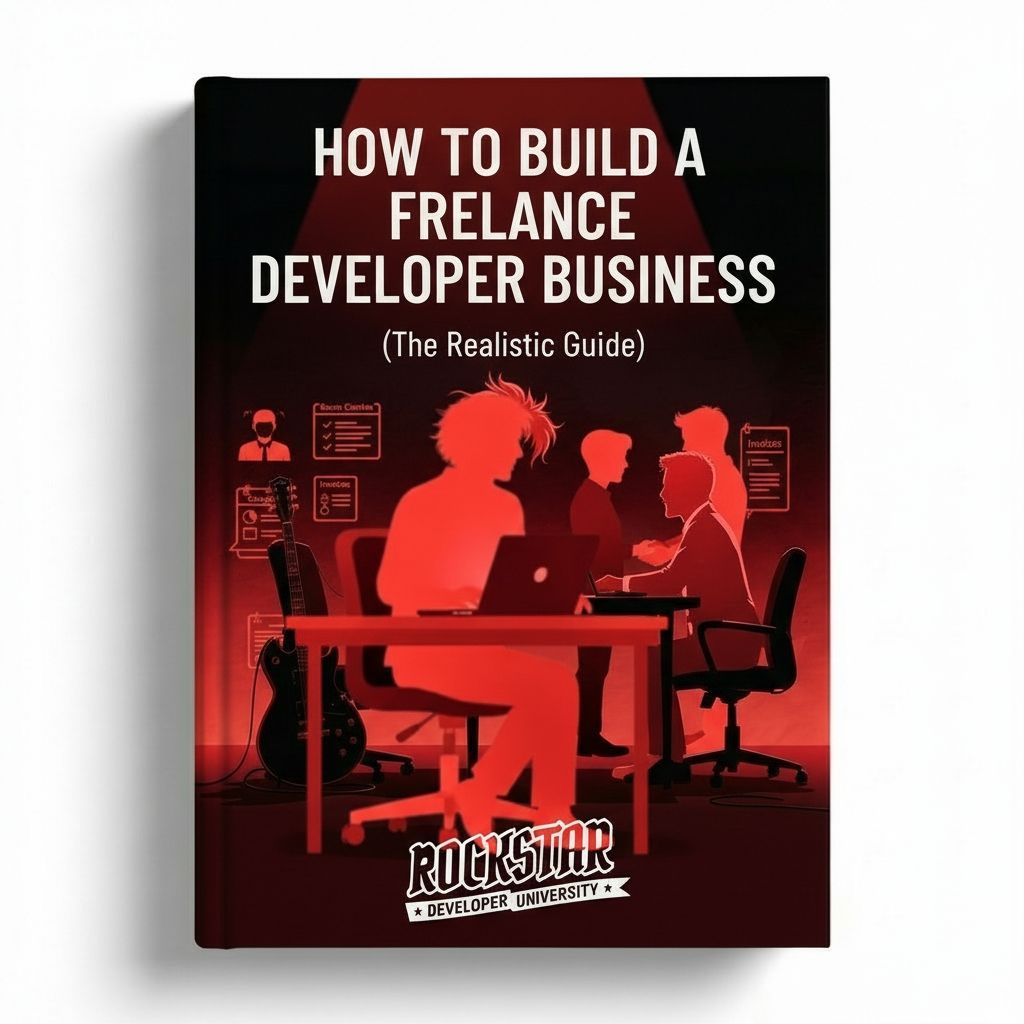
This guide is going to give you the honest truth about becoming a freelance developer in 2026. Not the sanitized version that makes it sound easy. Not the fear-mongering version that makes it sound impossible. Just what actually works, what doesn't, and how to give yourself the best possible shot at building a freelance career that lets you design your own life.
1. The Reality Check You Need Before Starting
Before we get into tactics, let's make sure you're going into this with the right expectations. Freelancing isn't for everyone, and there's no shame in deciding it's not for you.
First, understand that you're trading one set of problems for another. When you work at a company, someone else worries about finding customers, managing cash flow, paying taxes quarterly, and figuring out health insurance. As a freelancer, all of that becomes your job. You're not just a developer anymore,you're also the CEO, CFO, head of sales, and customer support of a one-person company.
Second, income volatility is real. You might make $15,000 one month and $3,000 the next. If that kind of unpredictability gives you anxiety, you'll need to either build a substantial financial buffer or develop strategies to smooth out the income (more on that later).
Third, isolation can be brutal. No more water cooler conversations. No more casual lunches with coworkers. No more spontaneous brainstorming sessions. For some people, that's a feature. For others, it's a slow descent into loneliness that affects both their mental health and their work quality.
Fourth,and this is the big one,you need to be honest about your risk tolerance. If you have a family depending on your income, significant debt, or health conditions that require consistent insurance coverage, jumping into full-time freelancing might not be the smartest first move. Starting as a side hustle while employed is often the smarter path.
None of this is meant to scare you off. It's meant to ensure that when you decide to freelance, you're doing it with open eyes. The developers who struggle most are the ones who expected freelancing to be pure freedom without any downsides. The ones who succeed are the ones who understood the trade-offs and decided they were worth it anyway.
2. Skills That Actually Matter for Freelancing
Obviously, you need technical skills. But how much? And which ones? The answer might surprise you.
You don't need to be a 10x engineer. You need to be competent enough to deliver what you promise, reliably, without hand-holding. That's a lower bar than most people think. A developer who can build a solid WordPress site, integrate a few APIs, and troubleshoot common issues is more than qualified to freelance. You're not competing for jobs at Google,you're solving problems for small business owners who just want their website to work.
That said, specialization matters. The generalist freelancer who does "everything" often ends up competing on price because they're interchangeable with thousands of others. The specialist who focuses on Shopify stores for jewelry brands, or React dashboards for SaaS companies, or API integrations for real estate platforms can charge premium rates because they understand the specific problems their clients face.
Beyond technical skills, you need a few things that most developers underestimate. Communication skills are probably the most important. Clients don't care how elegant your code is. They care that you understand their problem, keep them informed, meet deadlines, and don't disappear for days without updates. A developer who communicates well will beat a better developer who communicates poorly almost every time.
Project management skills matter too. You need to be able to estimate how long things will take (and pad those estimates appropriately), break work into deliverable chunks, and manage multiple clients without dropping balls. This isn't glamorous, but it's what separates the freelancers who burn out from the ones who build sustainable businesses.
Finally, you need sales skills. Not sleazy, used-car-salesman sales. Just the ability to talk to potential clients, understand their needs, articulate how you can help, and close deals. Many developers resist this, but there's no getting around it. No clients means no business.
Freelance success comes down to one thing: do clients know who you are?
Apply Now3. How to Find Your First Clients
This is where most aspiring freelancers get stuck. You've got skills, you're ready to work, but where are the clients? Let me break down the channels that actually work in 2026.
Your existing network is your best starting point. Tell everyone you know that you're freelancing. Former coworkers, college friends, family members, that person you met at a conference three years ago. You're not asking them to hire you directly (though some might). You're asking them to keep you in mind when someone they know needs development help. Word of mouth referrals are the highest quality leads you'll ever get because they come pre-validated with trust.
Freelance platforms are useful but limited. Upwork, Toptal, Fiverr, and similar platforms can provide work, especially when you're starting out. The downside is fierce competition, downward price pressure, and platform fees that eat into your margins. Use these to build experience and testimonials, but don't plan to rely on them forever. The goal is to graduate from platforms to direct clients as quickly as possible.
Outbound prospecting works if you do it right. This means reaching out directly to potential clients who might need your services. The key is specificity. Don't send generic "I'm a web developer and I'd love to work with you" emails. Instead, identify specific problems you can solve and lead with that. "I noticed your checkout page takes 8 seconds to load,I specialize in e-commerce performance optimization and could probably cut that in half" will get responses when generic pitches get deleted.
Content marketing builds long-term pipeline. Writing blog posts, creating YouTube tutorials, or sharing insights on LinkedIn positions you as an expert in your niche. This takes time to pay off,you're planting seeds that might take months to sprout,but the clients who find you through content are often the best clients. They already trust you because they've seen your expertise demonstrated.
Local businesses are underrated. While everyone fights for remote gigs from tech startups, there are restaurants, law firms, real estate agencies, and dentist offices in your town that need web work and don't know who to call. They can't evaluate your technical skills and don't care about your GitHub,they just want someone reliable who speaks their language. These clients often turn into long-term relationships with recurring work.
4. Setting Your Rates Without Leaving Money on the Table
Pricing is where most new freelancers make their biggest mistakes. Let me help you avoid the common traps.
First, forget hourly rates for project work. Hourly billing punishes you for being fast and creates adversarial dynamics with clients who are watching the clock. Instead, quote fixed prices for defined scopes of work. This lets you capture more value when you're efficient and gives clients budget certainty they appreciate.
Second, don't price based on your old salary. Just because you made $80,000 a year as an employee doesn't mean you should charge $40/hour as a freelancer. Remember, you're now covering your own benefits, paying self-employment taxes, handling unpaid time between projects, and taking on business risk. A reasonable rule of thumb is that your effective hourly rate (for internal calculations) should be at least 2-3x what you'd make per hour as an employee to achieve the same take-home pay.
Third, price based on value, not time. If you're building an e-commerce feature that will generate $50,000 in additional annual revenue for a client, charging $5,000 for that work is entirely reasonable,even if it only takes you two weeks. Clients are paying for the outcome, not your hours.
Fourth, raise your rates faster than feels comfortable. Most freelancers underprice for too long out of fear of losing clients. The reality is that higher prices often attract better clients,the ones who value quality over cheapness and are easier to work with. If you're closing every proposal, your rates are too low. You want to win about 25-50% of the projects you bid on.
A practical starting point for a competent freelance developer in 2026: $75-150/hour equivalent for project work, depending on your specialty and location. Don't go lower unless you're deliberately trading money for experience and testimonials. Specialists in lucrative niches (fintech, healthcare, enterprise integrations) often charge $200-400/hour or more.
5. Building a Portfolio That Wins Clients
Your portfolio is your sales tool. It needs to do more than show you can code,it needs to convince potential clients that you can solve their specific problems.
Quality beats quantity. Three case studies that tell a compelling story are better than twenty screenshots with no context. For each project, explain the client's problem, your approach to solving it, the challenges you encountered, and the measurable results you achieved. "Increased checkout completion rate by 23%" is more convincing than "built a checkout page."
If you're just starting and don't have client work to show, create spec projects. Build the kind of work you want to get hired for. Want to work with restaurants? Build a demo restaurant site with online ordering. Want to work with SaaS companies? Build a demo dashboard with realistic data visualization. Treat these spec projects as seriously as paid work,they're your portfolio's foundation.
Include testimonials whenever possible. Social proof matters enormously in freelancing because clients are taking a risk on someone they don't know. Even a short quote from a satisfied client adds credibility. Ask every client for a testimonial when the project wraps up (not before,wait until they're happy with the results).
Make your portfolio easy to navigate. Decision-makers are busy. They want to quickly understand what you do, see proof you can do it, and know how to contact you. Don't bury the good stuff beneath clever design. Function over form.
6. The Business Side You Can't Ignore
Freelancing means running a business. Here's the minimum viable business infrastructure you need.
Legal structure: In the US, many freelancers start as sole proprietors (the default when you do business under your own name) and later form an LLC for liability protection. Consult with an accountant or lawyer about what makes sense for your situation,the right structure depends on your income level, risk tolerance, and state.
Contracts are non-negotiable. Never start work without a signed contract that defines the scope, deliverables, timeline, payment terms, and what happens if things go wrong. This protects both you and the client. Many freelancers use templates from services like Bonsai, HelloSign, or AND.CO as starting points.
Get paid properly. Require deposits before starting work (25-50% upfront is standard). Use invoicing software that makes it easy for clients to pay. Set clear payment terms and follow up immediately when invoices are late. Cash flow problems sink more freelance businesses than lack of work.
Taxes will eat you alive if you're not prepared. As a freelancer, you're responsible for paying quarterly estimated taxes, including self-employment tax (Social Security and Medicare). Set aside 25-35% of every payment you receive in a separate account for taxes. This isn't optional,underpaying estimated taxes leads to penalties.
Health insurance is your problem now. In the US, options include marketplace plans (healthcare.gov), spouse's employer plan, or freelancer-focused options like the Freelancers Union. Budget for this,it's one of the biggest expenses you'll face as a freelancer.
The highest-paid freelance developers aren't the most skilled. They're the most visible.
Apply Now7. Managing Clients Without Losing Your Mind
Client management is where many freelancers struggle. Here's how to make it sustainable.
Set expectations early and clearly. What are your working hours? How quickly do you respond to emails? How do you handle scope changes? What's your revision policy? Communicate all of this before starting work. Most client conflicts stem from mismatched expectations that weren't discussed upfront.
Communicate proactively. Don't wait for clients to ask for updates,send them before they have to ask. A quick end-of-day email summarizing progress and next steps takes five minutes but builds enormous trust. Clients hate silence. When they don't hear from you, they assume the worst.
Learn to say no. Not every potential client is a good fit. Red flags include unrealistic budgets, impossible deadlines, poor communication during the sales process, and disrespect for your expertise. Turning down bad-fit clients protects your sanity and creates space for better opportunities.
Fire bad clients when necessary. Some client relationships are toxic and can't be fixed. If a client is consistently disrespectful, pays late repeatedly, or makes your life miserable, it's okay to end the relationship professionally. Finish any committed work, provide transition documentation, and move on. Your mental health is worth more than any single client.
Build long-term relationships, not one-off transactions. The best freelance businesses run on repeat clients and referrals. Treat every client as a potential ongoing relationship. Ask about their future plans. Check in after projects end. Be the first person they think of when new work comes up.
8. Avoiding Burnout in the Long Game
Freelancing freedom can easily become freelancing prison if you don't set boundaries. Here's how to stay sustainable.
Set real working hours and stick to them. Just because you can work at 11 PM doesn't mean you should. Define your working hours and protect them. Reply to client emails during business hours only. Your availability training starts from day one,if you respond instantly at all hours, clients will expect it forever.
Take real time off. As a freelancer, there's always more work you could be doing,more prospecting, more skill-building, more billable hours. This mindset leads to burnout. Schedule vacations. Take weekends. Your business won't collapse from a week off, but you might collapse from never taking one.
Build a financial buffer. Having 3-6 months of expenses saved removes the desperation that leads to accepting bad clients and working through exhaustion. Financial security gives you the ability to say no, take breaks, and make decisions from a position of strength.
Connect with other freelancers. Join communities (online or local) of people who understand what you're going through. The isolation of freelancing is real, and having peers who get it makes an enormous difference. They can also become referral sources, collaborators, and genuine friends.
Remember why you started. Freelancing is supposed to give you a better life. If you're working more hours than you did as an employee, making less money, and feeling more stressed, something needs to change. The whole point is building a career that serves your life, not the other way around.
9. The Transition: Employee to Freelancer
How do you actually make the jump? Here's a practical path.
Start while employed. Use nights and weekends to take on small projects, build your portfolio, and learn the business side. This is safer than quitting and figuring it out later. You'll learn whether you actually enjoy freelancing before betting your livelihood on it.
Build your runway. Save enough to cover 6-12 months of expenses before going full-time. This gives you the luxury of being selective about clients and weathering slow periods without panic.
Leave on good terms. Your employer and coworkers become part of your network. Give proper notice. Document your work. Offer to help with the transition. Many freelancers get their first clients from former employers who need ongoing help after they leave.
Don't burn the bridge. If freelancing doesn't work out, having the option to return to employment (at your old company or elsewhere) is valuable. There's no shame in trying something and deciding it's not for you.
Start with a specialization. Even if you want to be a generalist eventually, starting with a specialty makes marketing easier and commands higher rates. You can always expand later once you're established.
10. What Success Actually Looks Like
Let me paint a realistic picture of successful freelancing so you know what you're aiming for.
After about a year of serious effort, a successful freelance developer typically has 3-5 regular clients who provide most of their work through ongoing projects or retainers. They're not scrambling for every gig on Upwork,work comes primarily through referrals and repeat business. They're charging rates that exceed what they made as an employee when adjusted for the additional costs and risks of self-employment.
They've got systems: templates for contracts and proposals, a process for onboarding clients, accounting handled (usually by hiring help), and boundaries that keep work from consuming their life. They've learned to say no to work that doesn't fit, and they're not afraid of short gaps between projects because they have savings and confidence that more work will come.
Most importantly, they're designing their life intentionally. Maybe that means working four days a week. Maybe it means traveling while working. Maybe it means being available for their kids after school. The specifics vary, but the common thread is that freelancing serves their life goals rather than consuming them.
Getting there takes time. Most developers need 1-2 years to build a sustainable freelance practice. The first six months are usually the hardest,finding clients, figuring out pricing, making all the first-time mistakes. But if you persist through that period, you'll have built something genuinely valuable: a career that's yours.
The developers who make it aren't necessarily the most talented. They're the ones who treated freelancing as a skill to be learned, kept showing up when it got hard, and refused to quit before they figured it out.
You can be one of them.