You're preparing for a senior java developer interview. Maybe it's at a top tech company or an enterprise that runs java applications everywhere. Either way, the interview process will test more than basic syntax. Interviewers expect senior java developers to understand core java deeply, design systems thoughtfully, and lead technical decisions. Let me show you the top java developer interview questions you'll face and how to answer them with confidence.
Java senior developer interview questions cover a range of topics from core java concepts to advanced topics like multithreading in java, design patterns, and system design. The interviewer wants to see that you can write production-quality java code, understand the java virtual machine, and make smart architectural choices. Prepare for these programming interview questions with examples from your work experience and you'll walk in confident. These java technical interview questions will help you ace your next java developer interview. Whether you're interviewing at a startup or an enterprise company, these interview questions for senior java developers will prepare you thoroughly. This guide covers the top java interview questions and answers that every java developer should know.
1. Core Java Interview Questions and Answers for Senior Developers
Every senior java developer interview starts with core java fundamentals. Even with years of experience working with java, you need to explain the concept of java clearly. The interviewer uses these core java interview questions to establish baseline competence before moving to advanced topics. These developer interview questions test your foundation in the java language. Let me explain the concept behind each java interview question and show you how to answer java interview questions and answers effectively. Expect a senior java developer interview to cover these foundational topics thoroughly.
What is the difference between an abstract class and an interface in java? An abstract class can have both abstract methods and concrete methods with implementation. An interface in java traditionally only had abstract methods, though java 8 introduced default methods. A class can implement multiple interface contracts but extend only one abstract class. Use abstract classes when you have shared state or implementation. Use interface definitions for defining contracts between java components. The functional interface concept was introduced in java 8, enabling lambda expressions. Understanding abstract and concrete methods and interface design is fundamental for any senior java developer role in software development.
Explain the difference between == and equals() in java. The == operator compares reference equality for objects. It checks if two references point to the same object in memory. The equals() method compares value equality when properly overridden. String and Integer override equals() to compare content. When you override equals(), always override hashCode() too. This is one of the most common java interview questions and answers you'll encounter.
What is the difference between String, StringBuilder, and StringBuffer in java? String is immutable in java. Every modification creates a new String object. StringBuilder is mutable and not thread-safe, making it faster for single-threaded string manipulation. StringBuffer is mutable and thread-safe due to synchronized methods, but slower than StringBuilder. Senior java developers choose StringBuilder for performance when thread safety isn't required. This demonstrates your java programming best practices and is commonly asked in java developer interview questions.
How does HashMap work internally in java? HashMap stores key-value pairs using an array of buckets. When you put a key-value pair, HashMap computes the key's hashCode(), finds the bucket index, and stores the entry. If multiple keys hash to the same bucket (collision), HashMap uses a linked list. Java 8 converts linked lists to balanced trees when buckets exceed a threshold, improving worst-case lookup from O(n) to O(log n). Understanding HashMap internals demonstrates deep java knowledge and is essential for interview questions for senior developers.
What are the differences between ArrayList and LinkedList in java? ArrayList uses a dynamic array to store elements while LinkedList implements a doubly-linked list structure. ArrayList provides O(1) access time for get operations but O(n) for insertions in the middle. LinkedList provides O(1) insertions but O(n) access time. Choose ArrayList when you need random access and LinkedList when you need frequent insertions and deletions. Java supports both implementations through the List interface. This is a fundamental collection in java that every senior developer must understand.

2. Principles of Object-Oriented Programming and OOP Interview Questions
OOP forms the foundation of java programming. Senior java developers must explain the concept of these principles and demonstrate when to apply each one. Expect interview questions that connect oop theory to practical software development scenarios. Understanding the principles of object-oriented programming is critical for any java developer interview. Java uses oop concepts throughout the java language and java collections framework. These java developer interview questions test whether you understand how to structure a java program using object-oriented principles. Interviewers frequently ask java interview questions about inheritance, polymorphism, and encapsulation.
Explain the four pillars of OOP in java. Encapsulation bundles data with methods that operate on that data, hiding internal state using access modifiers. Inheritance allows classes to inherit properties and behaviors from parent classes. Polymorphism lets objects take multiple forms through method overriding and method overloading. Abstraction hides complex implementation details behind simple interfaces. Every java class and java object follows these principles. Give concrete examples from software projects you've built using java applications.
What is the SOLID principle in java development? SOLID is a set of five design principles for writing maintainable object-oriented java code. Single Responsibility means each class has one reason to change. Open/Closed means java classes should be open for extension but closed for modification. Liskov Substitution means subtypes must be substitutable for their base types. Interface Segregation means clients shouldn't depend on interfaces they don't use. Dependency Inversion means high-level modules shouldn't depend on low-level modules. Senior java developers apply SOLID principles daily in software engineering. Understanding these principles is essential for java interview questions.
When would you use composition over inheritance in java? Favor composition when you need flexibility. Inheritance creates tight coupling between parent and child classes. Composition allows you to change behavior at runtime by swapping components. The classic example is a game character that can have different weapons through composition rather than inheriting from a WeaponUser class. Use inheritance only when there's a true "is-a" relationship. This shows your understanding of java development best practices.
Explain polymorphism and method overriding in java. Polymorphism allows one interface to be used for different data types. In java, polymorphism works through inheritance and interface implementations. Method overriding occurs when a subclass provides a specific implementation of a method defined in its parent class. The @Override annotation helps the compiler verify the method overriding is correct. Understanding polymorphism and interface usage is essential for writing flexible java code. This oop concept appears throughout java collections and java applications. The principles of object-oriented programming including method overriding are tested frequently in java developer interview questions.
3. Multithreading in Java: Concurrency and Thread Interview Questions
Multithreading separates senior developers from junior ones. Concurrency is complex, and interviewers want to see that you understand thread safety, synchronization, and common pitfalls. These java interview questions test your ability to write correct concurrent code. Understanding multithreading in java is essential for building scalable java applications.
What is the difference between synchronized and volatile in java? Synchronized provides mutual exclusion and visibility. Only one thread can execute a synchronized block at a time. Volatile only provides visibility, ensuring all threads see the latest value of a variable. Use synchronized when multiple operations need to be atomic. Use volatile for simple flags or single-variable state.
What causes deadlock in java and how do you prevent it? Deadlock occurs when two or more threads wait indefinitely for locks held by each other. Four conditions must be present: mutual exclusion, hold and wait, no preemption, and circular wait. Prevent deadlock by acquiring locks in a consistent order, using timeouts, or using java.util.concurrent utilities like ReentrantLock with tryLock().
Explain the difference between Runnable and Callable in java. Runnable's run() method returns void and cannot throw checked exceptions. Callable's call() method returns a result and can throw exceptions. Use Callable with ExecutorService when you need to return values from concurrent tasks. Future objects hold the eventual results of Callable executions.

4. Java 8 Features and Java Interview Questions and Answers
Java 8 transformed how developers write java code. Lambda expressions, streams, and optional changed java programming significantly. Expect interview questions about these features in any senior java developer interview.
What are lambda expressions in java 8? Lambda expressions provide a concise way to represent anonymous functions. They enable functional programming in java. Lambda syntax is (parameters) -> expression or (parameters) -> { statements }. Lambdas work with functional interfaces that have exactly one abstract method.
Explain the Stream API in java 8. Streams provide a declarative way to process collections. Operations are lazy and can be parallelized easily. Common operations include filter, map, reduce, collect, and forEach. Streams don't modify the source collection. Understanding streams is essential for modern java programming.
What is Optional in java 8 and why use it? Optional is a container that may or may not contain a non-null value. It helps avoid NullPointerException by making null handling explicit. Use Optional for return types when a method might not return a value. Methods like orElse(), orElseGet(), and orElseThrow() provide clean null handling.
5. Design Patterns and System Design for Senior Java Developer Interview
Design patterns and system design questions differentiate senior java developers from mid-level ones. Interviewers want to see that you can architect solutions, not just write code. These interview questions test your ability to design scalable java applications.
What design patterns do you use most frequently in java? Singleton ensures only one instance exists. Factory Method creates objects without specifying exact classes. Strategy encapsulates algorithms and makes them interchangeable. Observer defines one-to-many dependencies between objects. Builder constructs complex objects step by step. Explain patterns you've actually used in production java code.
How would you design a scalable java application? Start with clear separation of concerns. Use dependency injection for loose coupling. Design for horizontal scaling with stateless services. Implement caching strategically. Use message queues for asynchronous processing. Consider microservices when appropriate. Senior java developers think about scalability from the start.
6. Spring Framework and Java Development Interview Questions
Spring Framework dominates enterprise java development. Most senior java developer positions require Spring knowledge. Expect interview questions about Spring Boot, dependency injection, and common Spring modules.
What is dependency injection and how does Spring implement it? Dependency injection is a design pattern where objects receive their dependencies rather than creating them. Spring uses the IoC container to manage object creation and wiring. Use @Autowired, @Inject, or constructor injection. Constructor injection is preferred for required dependencies.
What is the difference between @Component, @Service, @Repository, and @Controller? All are specializations of @Component for component scanning. @Service indicates business logic classes. @Repository indicates data access classes and enables exception translation. @Controller indicates web controllers for MVC. Use the appropriate annotation to express intent and enable Spring features.
7. SQL and Database Interview Questions for Senior Java Developers
Senior java developers work with databases constantly. Expect interview questions about JDBC, ORM frameworks like Hibernate, and SQL optimization. Database knowledge is essential for building performant java applications in software engineering.
What is the difference between JDBC and Hibernate in java? JDBC is the low-level java API for database connectivity. You write SQL queries directly. Hibernate is an ORM that maps java objects to database tables. It generates SQL automatically and manages object state. JDBC offers more control; Hibernate offers productivity. Many java applications use both.
How do you optimize database queries in java applications? Start with proper indexing on frequently queried columns. Use EXPLAIN to analyze query execution plans. Avoid N+1 query problems by using eager loading or batch fetching in Hibernate. Write efficient SQL queries: select only needed columns, use appropriate joins, limit result sets. Consider caching frequently accessed data.
8. Java Virtual Machine, Garbage Collection, and Performance Interview Questions
Understanding the JVM is crucial for senior java developers. These interview questions for senior developers test your knowledge of how java runs and performs. The garbage collector, memory management, and runtime optimization are key topics you need to master.
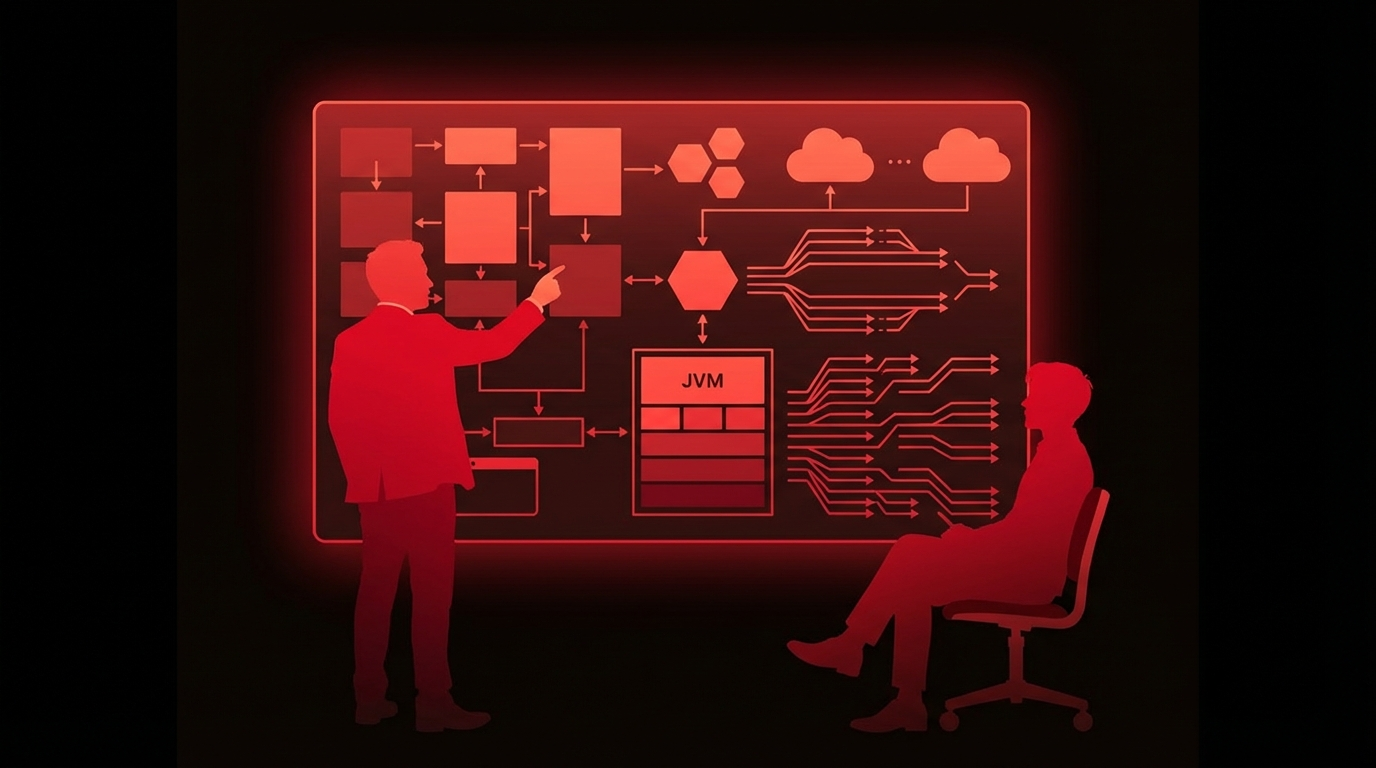
Explain the java virtual machine architecture. The java virtual machine executes java bytecode on any platform. The JVM includes the class loader, runtime data areas (heap, stack, method area), and execution engine. The java development kit includes tools for compiling and debugging. The java runtime environment contains the JVM and libraries needed to run java applications.
How does garbage collection work in java? Garbage collection automatically reclaims memory from objects no longer referenced. The garbage collector runs in the background, identifying and removing unused objects. Java uses generational garbage collection with young and old generations. Different garbage collectors (G1, ZGC, Parallel) offer different trade-offs.
How do you identify and fix memory leaks in java? Memory leaks occur when objects remain referenced but aren't used. Use profiling tools to identify memory leaks. Common causes include static collections that grow indefinitely, unclosed resources, and listeners not being unregistered. Fix leaks by ensuring proper cleanup and using weak references where appropriate.

9. Why Personal Branding Matters for Senior Java Developer Interviews
Here's something most java interview guides skip over. The developers who get the best offers aren't just technically strong. They walk into interviews with credibility already established.
Think about two senior java developers with identical skills interviewing for the same role. One applies cold with a solid resume. The other has built a personal brand through technical blog posts, open source contributions, or conference talks about java development. The hiring manager already knows their name. Who gets more leeway when they stumble on a question? Who negotiates the higher compensation?
Personal branding is a multiplier for your technical skills. You could be the best java developer in the world, but if nobody knows you exist, that expertise doesn't create opportunities. Start building your visibility now. Write about java concepts you're learning. Contribute to open source java projects. Share your knowledge in developer communities. The compound effect transforms your career trajectory over time.
10. How to Prepare: Mock Interview and Java Technical Interview Questions
Preparation makes the difference between struggling and succeeding in a senior java developer interview. Start by reviewing core java concepts. Even experienced java developers forget details they don't use daily. Practice coding problems on platforms like LeetCode using java programming.
Review your past software projects. Interviewers ask about real work experience, not just theoretical knowledge. Be ready to explain technical decisions you made and problems you solved in java development. What design patterns did you use? How did you handle scaling challenges? What would you do differently?
Practice explaining java concepts out loud. Technical interviews require clear communication. You might know HashMap internals perfectly but stumble when explaining them. A mock interview with peers helps identify weak spots in your explanations.
Study the source code of open-source java projects. Reading well-written java code improves your understanding of best practices. Understand how popular frameworks implement features. This knowledge helps you answer in-depth questions about java development.
11. Taking Action: Java Programming and Software Development Interview Prep
Start today. Pick three java topics you feel weakest on and review them this week. Read the documentation, write example java code, and explain the concept to someone else. Focus on areas like multithreading, java collections, and design patterns.
Schedule practice sessions. Aim for at least one hour daily of interview preparation for two to four weeks before your java interview. Cover data structures, algorithms, and java-specific topics in rotation.
Build something with java. The best preparation combines study with practice. Create a small project using Spring Boot and implement features that demonstrate senior-level skills: proper exception handling, logging, testing, and clean architecture. This gives you concrete examples to discuss in interviews.
Senior java developer interviews test breadth and depth. Prepare thoroughly, practice explaining your experience, and walk in confident that you can handle whatever interview questions come your way.
12. Advanced Java Interview Questions: Hashcode, Unchecked Exceptions, and More
Beyond the basics, senior java developer interviews often include advanced java topics. These interview questions for senior candidates test deep java knowledge that separates experienced developers from intermediate ones.
How does java handle serialization? Serialization converts java objects to byte streams for storage or transmission. Implement the Serializable interface to enable serialization. Use transient keyword to exclude fields. Custom serialization uses writeObject and readObject methods. Be aware of serialization security risks in java applications.
What is reflection in java? Reflection allows java code to examine and modify its own structure at runtime. The java.lang.reflect package provides classes for inspecting java classes, methods, fields, and interfaces. Use reflection for java frameworks, testing, and dynamic class loading. Reflection has performance costs and bypasses compile-time type checking.
Explain java generics and type erasure. Generics provide compile-time type safety for java collections and classes. Type erasure removes generic type information at runtime for backward compatibility. This means you can't use instanceof with generic types. Understanding generics is essential for writing reusable java code.
What are java annotations and how do you create custom ones? Annotations provide metadata about java code. Built-in annotations include @Override, @Deprecated, and @SuppressWarnings. Create custom annotations using @interface. Use retention policies to control when annotations are available. Spring and other java frameworks use annotations extensively for configuration.
13. Concurrent Java Programming: ArrayList, LinkedList, and Deadlock Questions
Concurrent programming is critical for senior java developers working on enterprise systems. Understanding how concurrent java applications handle multiple threads simultaneously separates senior developers from junior ones.
What is the Executor framework in java? The Executor framework provides thread pool management for concurrent java applications. Instead of creating threads manually, use ExecutorService to manage thread lifecycles. The Future interface handles asynchronous computation results. ThreadPoolExecutor offers fine-grained control over pool size, queue behavior, and rejection policies.
How do you handle concurrent modifications in java collections? Standard java collections throw ConcurrentModificationException when modified during iteration. Use concurrent collections from java.util.concurrent instead. ConcurrentHashMap provides thread-safe operations without blocking the entire collection. CopyOnWriteArrayList works well for read-heavy workloads with infrequent writes.
14. Abstract Class, Interface, and Programming Interview Questions for Senior Java Developers
Programming interview questions test your ability to write clean, efficient java code under pressure. Interview questions for a senior java developer often combine coding challenges with system design discussions.
How do you approach a java program coding question in an interview? Start by clarifying requirements with questions to ask the interviewer. Write pseudocode before diving into the java program. Test your solution with edge cases. Explain your thought process as you code. Interviewers care about how you think, not just whether you get the right answer.
What abstract class and interface questions should I expect? Expect questions about when to use an abstract class versus an interface in java. Know the differences: abstract classes can have state and constructors while interfaces define contracts. Since java 8, interfaces can have default methods. Understanding abstract class usage is fundamental for any java developer interview.
15. Top Java Interview Questions: Comprehensive List for Senior Developers
This comprehensive list of java interview questions covers everything senior java developers need to know. Whether you're facing interview questions for a senior java developer position at a startup or a large enterprise, these questions appear consistently. Review this list of top java interview questions alongside your technical preparation. Understanding these common java interview questions and their answers will help you explain the concept of java clearly during any senior developer interview.
16. Frequently Asked Java Interview Questions and Answers for Senior Developer Roles
What topics should I study for a senior java developer interview? Focus on core java concepts, object-oriented programming, multithreading in java, java 8 features, design patterns, Spring Framework, databases, and system design. Senior java interviews expect depth in these areas plus the ability to discuss real-world experience from software projects.
How long should I prepare for a senior java developer interview? Most candidates need two to four weeks of focused preparation. If you've been actively coding in java, you may need less time on fundamentals. Allocate more time to areas you haven't used recently, like advanced concurrency or system design.
What questions to ask the interviewer during a java interview? Ask about the team's java development practices, technology stack, and challenges they're facing. Questions to ask include what java version they use, how they handle technical debt, and what growth opportunities exist. Good questions demonstrate your interest in the senior java developer role.
Should I memorize java interview questions and answers? Understanding beats memorization. Study the concepts behind each java interview question so you can handle variations. Memorized answers fall apart when interviewers probe deeper. Focus on truly understanding HashMap internals, thread synchronization, and design patterns rather than rehearsing scripted responses.