Let's cut the nonsense. You've probably seen the headlines. "AI will replace 80% of developers by 2026." "The end of coding as we know it." "Junior developers are obsolete." And on the other side: "AI is just a tool." "Developers will always be needed." "Nothing to worry about."
So which is it?
I'm going to give you the straight answer, backed by actual data from 2025. Not speculation. Not what some CEO said to pump their stock price. What's actually happening in the job market, what the research really shows, and most importantly, what you can do about it.
The short version? Yes, things are changing fast. No, all developers aren't going to be replaced. But certain types of developers and certain types of jobs are absolutely being affected. If you understand what's happening and position yourself correctly, you can actually come out ahead. If you stick your head in the sand and pretend nothing's changed, you're in trouble.
1. The Numbers Don't Lie (But They Do Need Context)
Here's the data that's freaking everyone out: According to the U.S. Bureau of Labor Statistics, overall programmer employment in the United States fell 27.5 percent between 2023 and 2025. That's not a typo. More than a quarter of programming jobs disappeared in two years.
A Stanford Digital Economy Lab study found that employment among software developers aged 22 to 25 fell nearly 20 percent between 2022 and 2025. Entry-level hiring at the 15 biggest tech companies dropped 25 percent from 2023 to 2024 alone. These aren't small changes. This is a massive shift.
But here's where context matters.
That same BLS data shows software developers (a distinct category from programmers that involves more design and architecture work) only fell 0.3 percent in the same period. Basically flat. Meanwhile, information security analysts and AI engineers saw double-digit growth. The tech job market isn't dying. It's reshaping.
Hugo Malan, president of Kelly Services' tech staffing division, put it well: "The biggest impact by far has been on programmers," which he attributes to the "relatively solitary and highly structured nature of the work." Jobs that involve more human interaction, more ambiguity, more judgment calls? Those are holding steady or growing.
2. The Productivity Myth Everyone's Believing
You've probably heard the claims. "Developers are 50% more productive with AI!" "AI writes 25% of our code now!" Microsoft and Google have both claimed around a quarter of their code is AI-generated. Anthropic's CEO predicted that within six months, 90% of all code would be written by AI.
Sounds amazing, right? There's just one problem.
The actual research tells a different story. A July 2025 study by the nonprofit METR (Model Evaluation & Threat Research) found something fascinating: experienced developers believed AI made them 20% faster. When objectively tested? They were actually 19% slower. The productivity gain they felt was completely in their heads.
Mike Judge, a principal developer at Substantial, decided to test his own productivity. For six weeks, he flipped a coin to decide whether to use AI or code manually, then timed himself. AI slowed him down by a median of 21%, almost exactly matching the METR results.
He then went looking for evidence of this supposed productivity boom. More apps? More GitHub projects? More websites? He found flat lines everywhere. "Where's the hockey stick on any of these graphs?" he asked. "I thought everybody was so extraordinarily productive."
A September 2025 report from Bain & Company called real-world AI productivity savings "unremarkable." Stack Overflow's 2025 Developer Survey found trust and positive sentiment toward AI tools falling significantly for the first time, even as 65% of developers now use them weekly.
This doesn't mean AI coding tools are useless. They're great for boilerplate code, documentation, and getting unstuck. But the "10x productivity" claims? They're mostly hype. At least for now.
3. What AI Coding Tools Can Actually Do Right Now
Let's get specific. Most articles about AI and programming talk in vague generalities. Here's what the major tools actually do in practice.
GitHub Copilot is the most widely adopted AI coding assistant. It autocompletes code as you type, suggests functions, and can generate boilerplate from comments. GitHub claims that 46% of code on their platform is now AI-generated. That number sounds staggering until you realize most of it is repetitive patterns, test scaffolding, and standard implementations that experienced developers could write in their sleep. Their own research found developers completed tasks 55% faster with Copilot. But that study focused on a single, well-defined task: writing an HTTP server in JavaScript. Real-world development rarely looks that clean.
Cursor takes things further with better codebase awareness. It reads your project files and suggests multi-file changes that actually consider context. Claude Code operates as an agentic coding assistant, working through multi-step problems in your terminal, reading files, running tests, and iterating on solutions. These tools are genuinely useful. I use them myself.
Then there's Devin, which Cognition AI launched in 2024 as the "first AI software engineer." The demos were impressive. The reality? When independent researchers tested it, Devin successfully completed only 13.86% of real GitHub issues in the SWE-bench benchmark. That's better than nothing. But it's a long way from replacing a developer. It could handle straightforward bug fixes and small feature additions. Complex work? Not even close.
Here's what all these tools have in common: they're excellent at tasks with clear patterns and well-defined inputs. Write a CRUD endpoint? Great. Convert a design mockup to CSS? Pretty good. Generate unit tests for existing code? Solid. But ask any of them to design a system that handles 10 million users with 99.99% uptime across three continents, and they'll produce something that looks right but falls apart under real-world conditions.
The gap between "generating code" and "building software" is enormous. Most people outside the industry don't understand this distinction. Plenty of people inside the industry don't either.
AI can write code. It can't build your reputation. That's your unfair advantage.
Apply Now4. Why Some Developers Are Getting Hit Hard
Let's be honest about who's actually losing out here. If your job consists primarily of turning detailed specifications into code, you're vulnerable. If someone can describe exactly what they want and the only thing you add is typing it out in a programming language, AI can increasingly do that.
The jobs being cut aren't random. They follow a pattern. Junior programmers working on well-defined tasks. Maintenance programmers fixing straightforward bugs. Anyone whose work is "relatively solitary and highly structured," as Hugo Malan described it.
A survey from the National Association of Colleges and Employers found that 61% of employers say they're NOT replacing entry-level jobs with AI. That sounds reassuring until you realize it means 39% are either doing it or planning to. And 41% are discussing how to augment entry-level jobs with AI within five years.
The problem for new developers isn't just competition with AI. It's the elimination of the traditional training ground. Those grunt-work tasks that junior developers used to cut their teeth on? Many are being automated. Which means companies now expect new hires to hit the ground running with higher-level skills from day one.
As Jamie Grant from Penn's career services put it: new grads pursuing software engineering roles "are not necessarily just coding. There tends to be so much higher-order thinking and knowledge of the software development life cycle." You need to understand the whole picture, not just your piece of it.
5. What AI Actually Can't Do (Yet)
Here's where things get more hopeful. Despite all the breathless predictions, there's a long list of things AI struggles with.
AI can't sit in a meeting with a frustrated client who doesn't know what they want and help them figure it out. It can't deal with office politics. It can't negotiate with stakeholders who have conflicting requirements. It can't look at a codebase and understand the business reasons behind why things were built the way they were.
AI can't build relationships. And in software development, relationships matter more than most developers want to admit. Your ability to communicate with non-technical people, to understand what they really need (not just what they say they need), to push back appropriately when requirements don't make sense, that's extremely valuable.
Problem-solving and communication skills consistently rank at the top of what employers want. Not because they're nice-to-haves, but because they're the skills that make the difference between a project that ships successfully and one that technically works but misses the point.
The Stanford Digital Economy Lab found that jobs involving tasks that could be automated are more susceptible to employment dips, while jobs where AI augments rather than replaces human work are more stable. The key word is "augments." AI as your assistant, not your replacement.
Think about the last time you debugged a race condition in a distributed system. Or spent three days tracking down a memory leak that only appeared under specific load patterns on production servers. Or had to decide whether to use a message queue vs. direct API calls based on your team's size, operational maturity, and the specific failure modes your business can tolerate. AI doesn't do any of that well. It can't weigh those tradeoffs because it doesn't understand the organizational context behind them.
System architecture is a perfect example. Should you build microservices or a monolith? The answer depends on your team's experience, your deployment infrastructure, your scaling requirements, your budget, and about twenty other factors that are unique to your situation. AI will confidently recommend microservices because that's what the training data says is "best practice." But best practice for Google isn't best practice for a five-person startup. Knowing the difference is what makes a senior engineer valuable. And that knowledge comes from years of building real systems and watching some of them fail.
6. We've Seen This Movie Before
Every generation of developers thinks they're the first to face automation anxiety. They're wrong.
When COBOL was invented in 1959, the explicit goal was to let business people write their own programs. No more programmers needed. Grace Hopper literally described it as a way to make programming accessible to non-specialists. Sound familiar? That was over 65 years ago, and the number of programmers has done nothing but increase since then.
The pattern repeats constantly. In the 1990s, Visual Basic and other fourth-generation language tools were supposed to eliminate most coding work. Drag, drop, done. Then came WordPress, Squarespace, and Wix, tools that were going to kill web development. Then low-code and no-code platforms like Bubble and Webflow. Every single one of these technologies was going to make developers obsolete. Every single one of them ended up creating more demand for developers instead.
Why does this keep happening? Because automation lowers the barrier to building software, which means more people and companies want software built. The total demand for software grows faster than automation can replace the people building it. When WordPress made it easy to create basic websites, businesses didn't stop at basic websites. They wanted customization, integrations, e-commerce, and features that required actual developers. The baseline kept rising.
AI is more powerful than any of those previous waves. I'm not going to pretend otherwise. But the fundamental dynamic is the same. Making software creation easier and cheaper doesn't reduce demand for software. It explodes it. The question is whether developers adapt to the new tools or get stuck doing work that's being automated. That question has the same answer it's always had: the ones who adapt will thrive.
7. The Jensen Huang Philosophy
Nvidia CEO Jensen Huang has been saying the same thing since October 2023: "AI is not going to take your job. The person who uses AI is going to take your job."
I'll be honest, that line is overused at this point. But it contains truth.
Right now, proficiency with AI tools is basically an unwritten expectation at many companies. You don't have to love them. You don't have to believe all the hype. But you need to know how to use them effectively where they actually help.
That means understanding their limitations, too. Don't blindly accept AI-generated code without reviewing it. Don't share proprietary information with chatbots. Don't use AI as a crutch that prevents you from understanding what you're building.
The developers who will thrive are the ones who treat AI as a powerful tool in their toolkit, not a magic solution or an existential threat. They use it for boilerplate. They use it to explore unfamiliar technologies. They use it to generate first drafts. Then they apply their human judgment to make it actually work.
The developers who thrive in the AI era are the ones companies know by name.
Apply Now8. The Economics Nobody's Talking About
There's a concept in economics called the Jevons paradox. In 1865, William Stanley Jevons observed that when coal-burning engines became more efficient, total coal consumption went UP, not down. More efficiency meant coal could power more things, so demand skyrocketed. The same dynamic has played out with every major technology since.
Software development is following the exact same pattern. When AI makes it cheaper and faster to build software, what happens? More software gets built. Companies that couldn't afford custom applications before can now justify the investment. Departments that had to wait 18 months for an internal tool now want one every quarter. The backlog of desired software in every organization is essentially infinite. Making developers more productive doesn't shrink that backlog. It makes the backlog grow because stakeholders see what's possible and want more.
Marc Andreessen said "software is eating the world" back in 2011. That trend hasn't slowed down. If anything, AI is accelerating it. Healthcare needs more software. Agriculture needs more software. Manufacturing, logistics, education, government, every industry on Earth is being digitized. There aren't enough developers to build all the software the world wants, and AI making each developer more productive just means each developer can tackle more of that infinite backlog.
The U.S. Bureau of Labor Statistics projects that software developer roles will grow 17% through 2033, well above the average for all occupations. Even with all the AI disruption, even with the current job market turbulence, the long-term demand curve points up. The composition of developer work will change dramatically. The total need for humans who can build and manage software systems? That's not going away.
9. When Companies Try to Cut Developers
Want to know what happens when companies get too aggressive about replacing developers with AI? Look at Klarna.
Klarna's CEO Sebastian Siemiatkowski made headlines in 2024 by bragging about cutting staff through AI adoption. The company reduced its workforce from 5,000 to 3,800 employees, with AI supposedly handling the work of 700 customer service agents. Wall Street loved it. The stock price jumped. Then something interesting happened. Klarna started hiring again. Specifically, they started hiring software engineers. Turns out that building and maintaining all those AI systems requires, well, developers. The PR was better than the reality.
This pattern shows up everywhere. Companies announce massive AI-driven layoffs, get positive press coverage, then quietly backfill positions months later when things start breaking. The "vibe coding" trend is a perfect example of this dynamic playing out at the individual level. Developers use AI to rapidly generate entire applications, ship impressive demos, and then discover that the code is unmaintainable, filled with subtle bugs, and impossible to extend. The speed of creation creates a false sense of progress.
Code isn't the hard part of software development. It never has been. Understanding requirements, managing complexity, handling edge cases, maintaining systems over years, keeping them secure, scaling them reliably, integrating them with other systems: that's where the real work lives. AI can generate code fast. It can't own the outcomes.
10. How to Position Yourself for the Next Five Years
Alright, enough analysis. Here's what you should actually do.
Move up the abstraction ladder. Pure code-writing is increasingly commoditized. System design, architecture decisions, understanding trade-offs, those skills are more valuable than ever. If you're a junior developer, find ways to participate in design discussions. Don't just implement tickets, understand why they exist.
Get good at the human stuff. I know, developers often got into this field partly because they preferred computers to people. Too bad. The ability to communicate clearly, to manage stakeholder expectations, to work effectively with non-technical colleagues, these skills are becoming more important, not less. They're also much harder to automate.
Build expertise in growing areas. Security is booming. AI and machine learning (ironically) need human developers. Cloud infrastructure. DevOps. Data engineering. Find an area that's growing and get good at it. Generalist programmers are vulnerable. Specialists with deep expertise in growing fields are not.
Build your personal brand. When the job market gets competitive, people who are known for their work have a massive advantage. Write about what you're learning. Contribute to open source. Speak at meetups. The developers who have a reputation can choose their opportunities instead of fighting for whatever's available.
Learn how AI tools actually work. Not just how to use them, but their limitations and failure modes. Understanding when to trust AI output and when to be skeptical is itself a skill. The developers who can effectively supervise and direct AI tools are more valuable than those who can't use them at all.
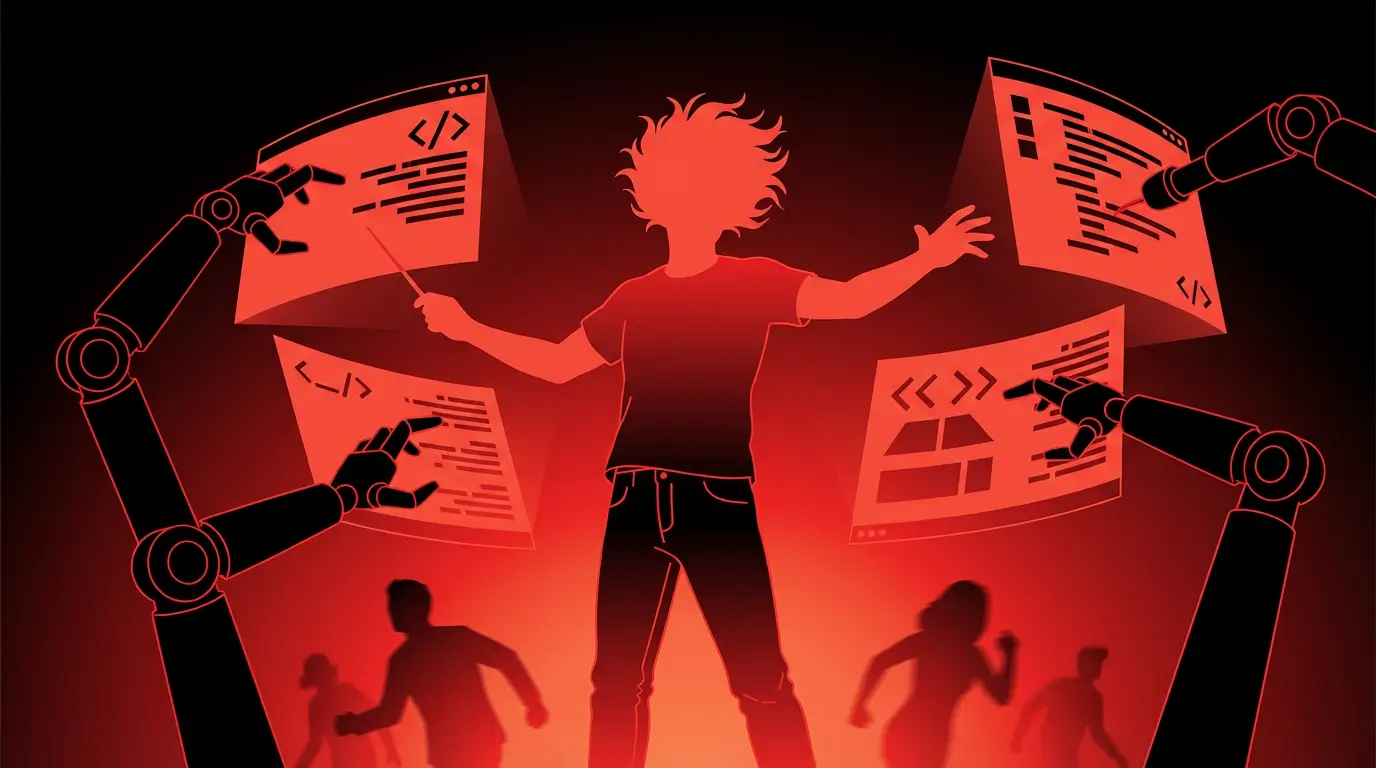
Understand that your role is changing, not disappearing. The developer of 2026 looks different from the developer of 2020. You're spending less time writing boilerplate and more time directing AI tools, reviewing their output, and making architectural decisions. Think of it as moving from typist to editor. Some people call this "prompt engineering," but it's really about knowing what to ask for and knowing when the answer is wrong. That requires deep technical knowledge, not less of it.
Invest in domain expertise. AI can write code in any industry. What it can't do is understand why a healthcare system needs HIPAA compliance, or why a financial trading platform needs sub-millisecond latency, or why a manufacturing system handles inventory the way it does. Developers who deeply understand their industry become translators between business needs and technical solutions. That kind of expertise takes years to build and can't be replicated by a language model trained on generic internet data.
11. The Bottom Line
Is AI replacing developers? Some of them, yes. The data is clear that certain types of programming jobs are declining fast.
Is AI going to replace all developers? No. Not in the next five years, probably not in the next twenty. Software development involves too much ambiguity, too many human factors, too much judgment that AI simply can't replicate yet.
The question isn't whether you'll still have a job. The question is what kind of job, and at what level. If you adapt, build the right skills, and position yourself as someone who solves problems rather than just writes code, you can actually thrive in this new era.
The developers who built their careers entirely around writing code in a specific language are the most vulnerable. The developers who built their careers around solving hard problems, understanding business domains, and communicating effectively with people are the least vulnerable. That's always been true, but AI is making the distinction sharper and more consequential than ever before.
You have to be intentional about it. The developers who assume everything will stay the same are the ones who'll be surprised when it doesn't. The ones who see change coming and prepare for it? They'll be fine. Better than fine, actually. They'll be the ones who get promoted, who command higher salaries, and who get to choose the projects they work on.
Stop worrying about whether AI will take your job. Start building the skills that make you the person who uses AI to do extraordinary work. That's the real competitive advantage. Not fighting the technology. Working with it while doing the things it can't.
The choice is yours.