Quick summary
How to recognize the signs, fight the causes, and build a sustainable career in software development
Let me tell you something most people in the tech industry won't say out loud. Developer burnout is real, it's common, and it will wreck your career if you don't deal with it. I've seen it happen to brilliant software engineers who loved their work. One day they're writing code with fire in their eyes, and six months later they can barely drag themselves to their desk.
I'm John Sonmez, founder of Simple Programmer and author of Soft Skills: The Software Developer's Life Manual.
I've been there myself.
The World Health Organization defines burnout as a syndrome conceptualized as resulting from chronic workplace stress that hasn't been successfully managed. That sounds clinical. But if you're a developer who's experienced burnout, you know what it actually feels like. It feels like the thing you once loved has turned into something you dread. It's not just being tired. It's a deep cynicism about your work, your team, and sometimes yourself.
Here's what's important to remember that burnout isn't a personal failure. It's a response to a broken system. And you can fix it, but only if you understand what's happening and take action before it destroys your motivation, your health, and your career.
1. What Is Developer Burnout and Why Does It Hit Software Engineers So Hard?
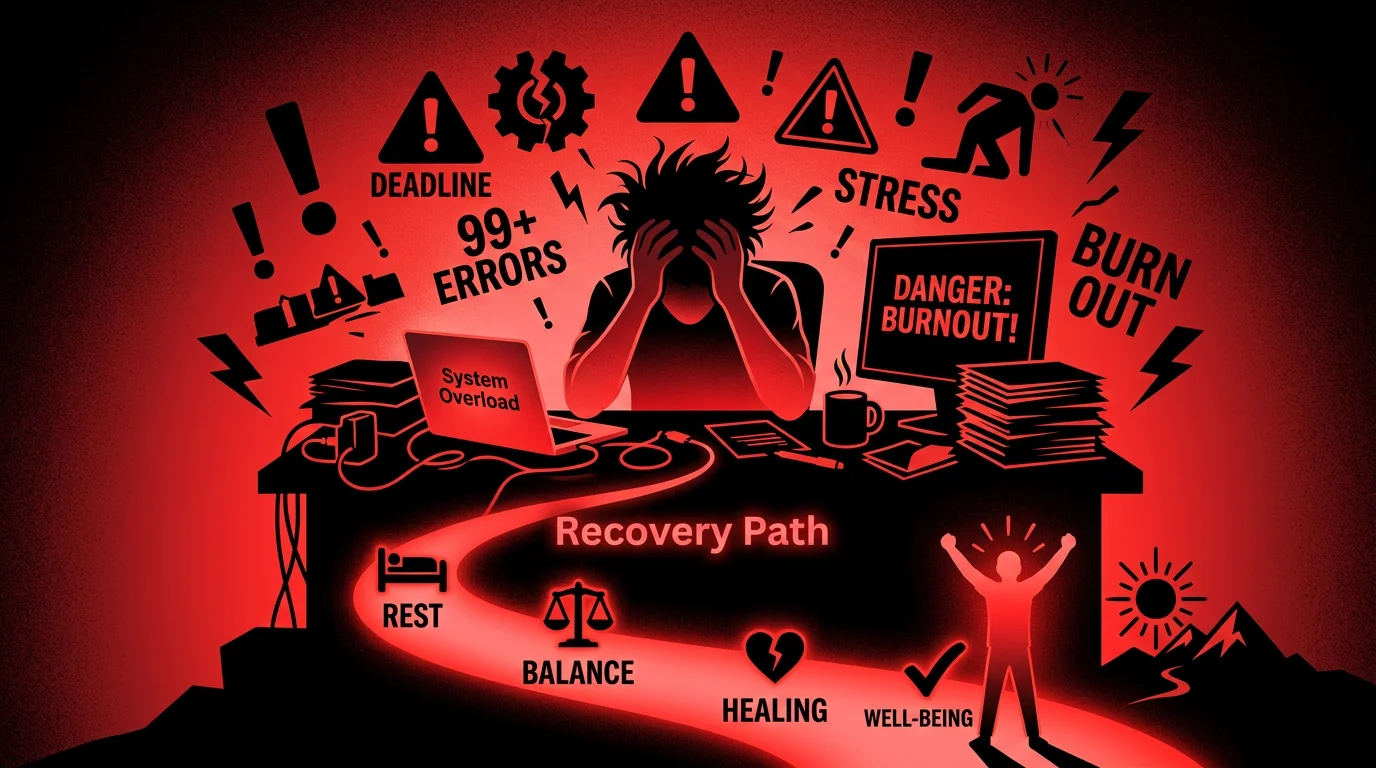
Developer burnout is what happens when a programmer spends too long under too much pressure without enough recovery. It's not just stress and burnout are different things. Stress is temporary. You feel stressed before a deadline, you ship the feature, and the stress goes away. Burnout is what happens when that stress never lets up.
Burnout is typically characterized by three things: exhaustion, cynicism, and a feeling that nothing you do matters. You stop caring about code quality. You stop caring about your team. Eventually you stop caring about your own career. It's a slow drain on your amount of energy until there's nothing left.
Software development is especially prone to this because the work never stops. There's always another ticket, another bug, another production fire. A Stack Overflow developer survey found that a huge percentage of developers have experienced burnout at some point. And it makes sense. The nature of the developer job means you're constantly solving problems with tight deadlines, shifting requirements, and mounting technical debt that nobody wants to address.
For a senior developer or tech lead, burnout is still a risk even though you'd think experience would help. In some ways, it gets worse. You're not just writing code anymore. You're in meetings and code reviews all day, mentoring junior devs, and firefighting production issues. The workload piles up and you wonder when you signed up for all of this.
2. The Real Causes of Burnout for Software Engineers and Developers
Let me break down the causes of burnout that I see most often in the software engineering world. Most of them aren't about the coding itself. They're about everything around it.
The first big stressor is unrealistic deadlines. When leadership promises a feature by Friday and the engineering challenges involved would realistically take three weeks, something has to give. Usually it's the developer who gives. You work long hours, skip your lunch, and ship something you're not proud of. Do that enough times and burnout is coming for you.
Then there's the lack of control. If you don't have any say in what you work on, how you work on it, or when you work on it, that feeling of helplessness will eat you alive. Developers need autonomy. When every decision gets made above you and handed down, your motivation dies. A lack of trust between managers and developers makes this even worse.
Technical debt is another silent killer. When you spend your days patching over bad code instead of building something meaningful, you feel like you're running on a hamster wheel. The quality of work suffers. You know you're doing a bad job but you don't have time to do a good one. That gap between what you could do and what you're forced to do is a direct path that can lead to burnout.
- Unclear or constantly changing requirements that make your work feel pointless
- Poor work-life balance from being on-call, working nights and weekends, or handling after-hours emergencies
- A toxic work environment where blame is common and recognition is rare
The workplace culture at your company plays a massive role too. If the company culture doesn't support open communication, if people are afraid to ask for help or push back on unreasonable demands, burnout spreads like a disease across the entire team. Burned-out developers create more stress for everyone around them, which burns out more people. It's a vicious cycle.
3. Signs of Developer Burnout That You Shouldn't Ignore
Here's the tricky thing about burnout. Most developers don't recognize burnout until it's already severe. The early signs are easy to dismiss because they look like normal parts of a tough job.
The first sign is that you stop caring about your work. You used to get excited about solving hard problems. Now you just want to get through the day. You cut corners on things you used to take pride in. Code quality drops. You stop writing tests. You start thinking "good enough" instead of "let me make this right."
Physical symptoms show up too. Headaches, trouble sleeping, getting sick more often, feeling tired even after a full night's rest. Your body is telling you something is wrong. Don't ignore it.
Cynicism is a huge red flag. When you start thinking that nothing you build matters, that your team is incompetent, or that the whole company is a joke, that's not clear thinking. That's burnout talking. There's an increased mental distance from your job. You show up physically but mentally you checked out weeks ago.
Other signs include avoiding your coworkers, dreading Monday mornings with a knot in your stomach, and a lack of positive feelings about anything work-related. You might find yourself scrolling reddit instead of coding, browsing job listings not because you want a new role but because you want to escape. If you've noticed yourself wanting to stop caring or already at the point where you did stop caring about your developer career, take that seriously.
Burnout thrives when your work feels replaceable and you have no real say in it. Grinding harder won't fix that. AI is making raw coding cheap, and the developers who set their own terms are the ones people already know by name. The free Rockstar Engineer Blueprint shows you how to become one of them, so the best jobs and offers come to you.
Get the Free Course4. How to Detect Burnout Before It Gets Worse
The best time to detect burnout is before it completely takes over your life. But how do you do that when you're deep in the middle of it?
Start by being honest with yourself about how you feel about your work. Not how you think you should feel. How you actually feel. When you sit down at your computer on Monday morning, what's your gut reaction? If it's dread, pay attention to that. It's important to understand what your emotional baseline looks like so you can notice when it shifts.
Track your energy. I'm not talking about some complicated system. Just notice when you feel energized by your work and when you feel drained. If you used to enjoy certain parts of software development and now they feel like a chore, that's a warning sign. If the thought of writing code makes you want to do anything else, that's a bigger warning sign.
Talk to people you trust outside of work. Sometimes the people closest to you notice changes before you do. Your spouse, your friends, your family, they might be seeing someone who's irritable, withdrawn, and exhausted. If the people who spend time with family and friends are telling you that you seem off, listen to them.
For managers who want to detect burnout in their teams, look for changes in behavior. A dev who used to contribute in meetings but now sits silently. A developer who used to ship clean code but is now cutting corners. A team member who used to stay engaged in team events but has withdrawn. These are signals that someone on your team is struggling.
5. The Cost of Developer Burnout for Your Career and Your Team
Here's why this matters beyond just how you feel. The cost of developer burnout is massive, both for the individual and the company.
For you personally, burnout kills your career momentum. When you're burned out, you're not learning new skills, you're not building your network, you're not growing. You're just surviving. And while you're in survival mode, other developers are passing you by. That promotion you wanted? It's going to someone else. That exciting project? It goes to the developer who still has energy and enthusiasm.
Burnout also destroys your health. Chronic stress is linked to heart problems, anxiety, depression, and a host of other issues. The fear of losing your job or falling behind keeps you grinding when your body and mind are screaming at you to stop. Your memory suffers. Your creativity dies. Your ability to learn new things disappears. You become a shadow of the developer you used to be.
For companies, the cost shows up in turnover, poor productivity, and declining software quality. Burned-out developers write bugged code, miss deadlines, and eventually quit. Then the company has to spend months finding and training a replacement. One study found that replacing a software engineer costs between 50% and 200% of their annual salary. That's an expensive problem that most companies still don't take seriously enough.
6. How to Prevent Developer Burnout in Your Coding Career
Preventing developer burnout isn't about reading a self-help book and thinking happy thoughts. It's about making real changes to how you work and how you live. Let me walk you through what actually works.
First, set boundaries and protect them. This means having a time when you close your laptop and you're done for the day. No checking Slack. No reviewing pull requests. No answering emails. Your brain needs time to rest and recover. If you work from home, this is even harder because the office is always right there. But you have to draw the line somewhere.
Second, learn to say no. This is the single biggest skill for avoiding burnout that most software engineers never develop. When your plate is full and someone tries to add more, you need to push back. Not aggressively. Just honestly. "I can take this on, but something else will have to wait. Which is the priority?" That's not being difficult. That's being professional.
Third, invest in things outside of work. The developers who burn out fastest are the ones whose entire identity is wrapped up in their job. When coding is all you do and all you are, any threat to your career feels like a threat to your entire self. Get hobbies. Exercise. Spend time with family and friends. Build a life that doesn't collapse if your job goes sideways.
- Take your vacation days. All of them. Your company won't fall apart without you for a week.
- Find a mentor or peer group where you can talk honestly about the hard parts of the job
- Move your body every day. Even a 20-minute walk changes your brain chemistry
The goal isn't to prevent burnout by becoming a person who doesn't care about their work. It's to build a healthy balance between caring about your craft and protecting your wellbeing. You want a long career in software development. You can't have that if you flame out every two years.
7. How to Prevent Developer Burnout When You're in a Remote Work or Hybrid Role
Remote work was supposed to fix everything. No commute, flexible hours, work in your pajamas. But for a lot of developers, working from home has made burnout worse, not better.
When you're remote, the boundaries between work and life blur completely. Your laptop is on the kitchen table. You check messages before breakfast. You do "one more thing" after dinner. Before you know it, you're working 12-hour days and wondering why you feel so terrible.
The fix for remote developer burnout starts with structure. Create a dedicated workspace, even if it's just a corner of a room. Have a start time and an end time. When you're done, walk away. Shut the laptop. This sounds simple but almost nobody does it consistently.
Also, fight isolation. Developers working remotely miss out on the casual conversations that happen in an office. Those small interactions matter more than you think. They make you feel connected to your team and remind you that you're part of something bigger than your ticket queue. Make an effort to have real conversations with your coworkers, not just about work. Join virtual team events when they happen. It can help improve the situation more than you'd expect.
A career is a marathon, and you can't run it flaming out every two years on work anyone could do. The developers who last are the ones their industry knows by name, so the raises and offers come looking for them. The free Rockstar Engineer Blueprint is a 5-day email course on becoming exactly that developer.
Get the Free Course8. What to Do When You've Already Experienced Developer Burnout
Maybe you're reading this and thinking, "I'm already past prevention. I'm burned out right now." If that's where you are, you're not alone, and you can come back from this.
The first thing is to admit it. A lot of programmers treat admitting burnout like admitting weakness. It's not. You've been pushing hard and your body and mind need to recover. That takes honesty, not toughness. Don't be afraid to ask for help from your manager, from a therapist, or from friends who've been through the same thing.
If you've recovered from burnout before, you know this already: it takes time. There's no quick fix. You need actual time to rest, not just a long weekend. If you can take a week or two off, do it. And don't spend that time on side projects or coding challenges. Step away from technology completely.
When you come back, change something. Burnout is still going to be waiting for you if you return to the exact same situation that caused it. Maybe that means having an honest conversation with your manager about your workload. Maybe it means switching teams. Maybe it means getting a new job at a better company to work for, one with a healthier workplace culture. The important thing is that something has to change.
Here's what I want you to understand. Your career is a marathon, not a sprint. You don't win by going as fast as possible until you collapse. You win by pacing yourself, staying in the game, and getting better over time. The best software engineers I know aren't the ones who grind the hardest. They're the ones who've figured out how to sustain their energy and their passion over decades.
9. Taking Action: Your Plan to Fight Developer Burnout Starting Today
I'm not going to let you finish this article without a plan. Reading about burnout and doing nothing about it is a waste of your time. Here's what I want you to do this week.
Today, do an honest self-assessment. On a scale of 1-10, how close are you to burnout right now? Be honest. Nobody's watching. If you're above a 5, you need to take action immediately.
Tomorrow, identify your biggest stressor at work. Is it the workload? Is it a toxic manager? Is it mounting technical debt? Is it the long hours with no end in sight? Name it. You can't fix what you won't name.
This week, have one honest conversation about how you're feeling. Talk to your manager, a trusted coworker, a mentor, anyone. Just say it out loud. "I'm feeling burned out and I need to make some changes." You'll be surprised how much that helps.
- Block 30 minutes today for a walk or some activity that has nothing to do with coding or software development
- Set a hard stop time for work today and honor it, no exceptions
- Write down three things about your developer job that you still enjoy. If you can't think of any, that's a sign you need bigger changes
Developer burnout isn't something that just goes away if you ignore it. It gets worse. But it is something you can fight, prevent, and recover from. The developers who build long, successful careers in software engineering are the ones who take their mental health as seriously as their technical skills. Don't wait until you're completely empty to start paying attention to this. Start today.
I cover burnout, productivity, and managing your energy as a developer in much more depth in Soft Skills: The Software Developer's Life Manual, if you want a sustainable approach to a long career.
Explore more on