Quick summary
Stop drifting between developer jobs. Map out a career that actually builds toward something worth having.
Most developers don't have a career path. They have a job. And there's a huge difference between the two. A job pays your bills. A career path builds something over time, where each move puts you in a better position than the last. If you're just bouncing between developer jobs without a plan, you're leaving money, growth, and opportunities on the table. I'm John Sonmez, founder of Simple Programmer and author of Soft Skills: The Software Developer's Life Manual.
I've spent over 15 years as a software developer, consultant, and entrepreneur. I've coached thousands of developers through career transitions, promotions, and salary negotiations. The pattern I see over and over is this: the developers who plan their career path end up earning more, doing more interesting work, and feeling less stuck. The ones who don't plan? They're the ones emailing me five years in wondering why nothing has changed.
So let's map it out. Whether you're just starting out, stuck in the middle, or trying to figure out what comes after senior developer, this guide covers every developer career path worth pursuing in software development today.
1. What Is a Software Developer? The Developer Career Explained
A software developer is someone who designs, builds, and maintains software. That's the short version. The longer version is that developers write code, debug problems, collaborate with teams, review other people's work, and spend a surprising amount of time in meetings. The specific work depends on your role, your experience level, your company, and what kind of software you're building. The field of software engineering is broad, and there's no single definition that covers every developer position out there.
Software developers work closely with product managers, designers, quality assurance testers, and other engineers to turn ideas into working products. Some developers focus on front-end development, building the front end of a website or application that users see and interact with using HTML, CSS, and JavaScript. Others focus on back-end development, building the back end server logic, databases, and APIs that power everything behind the scenes. Full stack developers do both. Web developers in particular cover a wide range of development roles, from building simple landing pages to complex web development projects that serve millions of users.
The field of software development is massive. Developers build web pages, mobile or web applications, desktop software programs, embedded systems, cloud computing platforms, and machine learning models. If something runs on a computer or compute environment, a developer built it. And the need for software developers keeps growing because every industry now depends on software to operate. There are many different types of software developers, and each type focuses on different problems. Some software developers focus on building software products for consumers. Others work on internal tools, research and development, or infrastructure that powers other software applications.
2. How to Become a Software Developer: Coding, Degrees, and Bootcamps
There's more than one path you choose to become a software developer, and none of them is the "right" one. The traditional route is a computer science degree. A four-year program in computer science and information technology gives you a solid foundation in algorithms, data structures, operating systems, and the theory behind how software works. It also makes it easier to get past the resume screening at larger companies.
But a computer science degree isn't the only way. Coding bootcamps have become a legitimate entry point for people pursuing a career in software. These programs run 12 to 16 weeks and focus on hands-on, practical coding skills. I've hired developers from bootcamp backgrounds who were just as capable as developers with traditional degrees. What matters is whether you can actually build software that works.
Self-teaching is also viable. If you're disciplined enough to work through online courses, build projects, and contribute to open source, you can absolutely land a developer job without any formal credential. The catch is that you need to become a software developer who can prove their skills through a portfolio, not just a resume. Whether you have a computer science degree or are completely self-taught, the skills you need to become a software engineer are the same: the ability to write clean code, solve problems, and work as part of a software development team.
Is 27 too late to start coding? No. Not even close. I've seen people switch careers into software development in their 30s and 40s and do extremely well. The tech industry values what you can build, not how old you were when you started. The idea that you need to start coding at 12 to succeed is a myth. What you need is consistency, the willingness to be bad at something before you get good, and a plan for how you'll build real experience in software. Software development is a rewarding career for people at any age, as long as they're willing to put in the work.
3. The Developer Career Path: From Junior to Senior Software Engineer and Beyond
Here's what the career progression for a developer typically looks like. Think of it as a career ladder with clear steps. Every company structures things a little differently, but the broad pattern is consistent across the industry.
Junior Developer (0-2 years)
As a junior developer, you're learning. You write code under the guidance of more experienced developers. You're picking up best practices, understanding the software development life cycle, and figuring out how your team works. The average salary for entry-level software developers in the United States ranges from $65,000 to $95,000.
The goal here isn't to be brilliant. It's to be reliable. Ship code that works. Ask good questions. Don't make the same mistake twice. That's what separates a junior developer who gets promoted from one who stays junior for years.
Mid-Level Developer (2-5 years)
A mid-level developer works independently. You can take a feature from requirements to production without someone holding your hand. You understand the software development processes your team follows, and you're starting to have opinions about how things should be built. You're also becoming someone that junior developers turn to for help.
At this level, your technical skills should be solid in at least one or two programming languages. If you're a web developer, you're comfortable with JavaScript, HTML, CSS, and at least one back-end language like Python or Java. Your average salary sits between $95,000 and $140,000.
Senior Developer (5-10 years)
A senior developer isn't just someone who's been coding for a long time. A senior software engineer leads projects, mentors other developers, makes architectural decisions, and takes ownership of outcomes. You're the person your team relies on when something breaks or when a tough design decision needs to be made.
I tell developers all the time: the jump to senior is less about coding ability and more about influence. Can you make the people around you better? Can you communicate clearly with non-technical stakeholders? Can you see problems before they become emergencies? That's what makes a senior developer. The salary range at this level jumps to $140,000 to $200,000, and significantly higher at major tech companies.
Lead Developer and Architect (10+ years)
Beyond senior, the path branches. On the technical side, you move toward lead developer, software architect, or principal engineer roles. These are the people who set the technical direction for entire teams or organizations. You're making decisions about which frameworks to use, how computer systems communicate, and how to ensure software meets performance, security, and reliability requirements. Engineers design and develop the systems that entire development teams depend on. Systems engineering at this level means thinking about how every piece fits together. At this level, your software development career is defined by the scope of your influence, not just the code you write. You're also shaping the workflow and development process for everyone around you.
Climbing the ladder one job title at a time is the slow path, and AI is eating the bottom rungs. The developers who move fastest stop waiting to be noticed and make sure their industry already knows their name, so the next role comes to them. The free Rockstar Engineer Blueprint is a 5-day course from John Sonmez on becoming the developer companies come looking for.
Get the Free Course4. Software Developer Career Paths You Can Pursue: Specialization in Front-End, Back-End, DevOps, and More
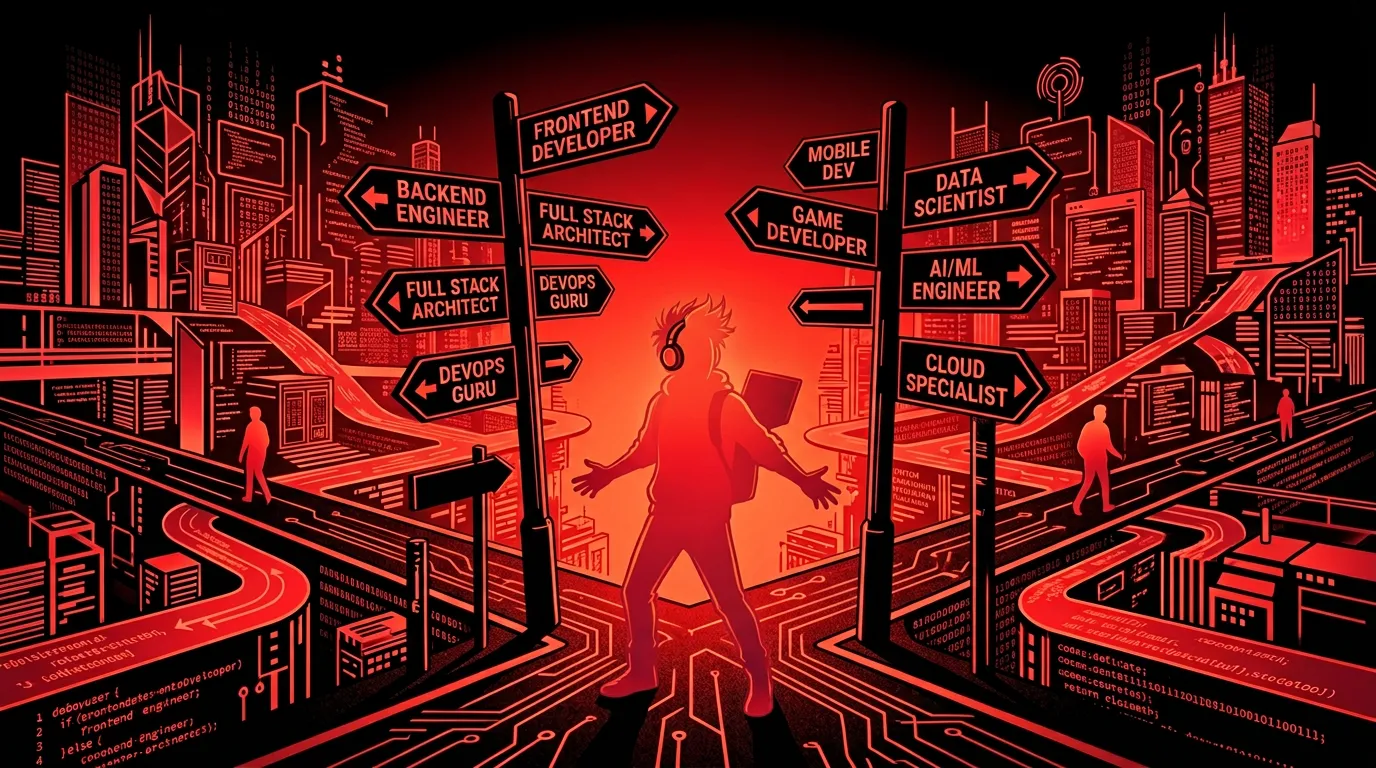
The standard junior to senior progression is one developer career path, but it's far from the only one. There are many developer positions across the industry, and the right one depends on your interests and strengths. Here are the most common software developer career paths that developers follow, along with what each one involves.
Front-End Developer: You build the user-facing side of web applications. Your tools are HTML, CSS, JavaScript, and frameworks like React, Angular, or Vue. Front-end developers work closely with designers to make sure the user experience feels right. The average salary ranges from $80,000 to $150,000 depending on experience.
Back-End Developer: You build the server-side logic, databases, and APIs that front-end and back-end developers depend on. You write code in languages like Python, Java, Node.js, or Go. Backend work involves designing data models, building APIs, and making sure everything performs well under load.
Full Stack Developer: You handle both front-end development and back-end development. Companies love full stack developers because you can build software end to end. The trade-off is that you might not go as deep in any single area as a specialist would.
Mobile Developer: You build mobile apps for iOS and Android that run on phones and tablets. Mobile development uses Swift and Kotlin as primary languages, and cross-platform frameworks like React Native or Flutter are popular too. Every company needs a mobile presence now, so demand stays strong.
DevOps Engineer: A devops engineer bridges the gap between development and operations. You build and maintain the infrastructure that other developers deploy to, automate pipelines, manage cloud computing resources on platforms like AWS or Microsoft Azure, and keep systems running. DevOps engineers are in extremely high demand and the salary reflects it, often $120,000 to $180,000.
Data Developer and Data Scientist: If you're comfortable with math, statistics, and programming languages like Python and SQL, a data career might be the best path. Data developers build the pipelines that move and transform data. Data scientists analyze that data using machine learning and artificial intelligence to find patterns and make predictions.
Embedded Engineer: You write code that runs on physical hardware and software systems. Think car software, medical devices, or IoT sensors. Embedded work often uses C and C++ and requires understanding how hardware and software interact at a low level.
Quality Assurance Engineer: QA developers focus on testing software to make sure it works correctly. This can include manual testing, automated testing, and building test frameworks. Quality assurance is a great entry point into a development career because it teaches you how software breaks. Developers typically work alongside QA engineers as part of software development teams to understand the software development process end to end.
React Developer or Framework Specialist: Some developers build entire careers around a specific framework or ecosystem. A React developer who knows the library inside and out is extremely valuable to companies with large React codebases. The same applies to developers who specialize in Angular, Vue, Kubernetes, or other focused technologies.
5. How Much Does a Software Developer Earn? Average Salary at Every Level
Salary is a big factor in career development, so let's be specific about what you can expect. These numbers are for the United States and reflect total compensation including base salary and bonuses.
A junior developer or entry-level programmer earns $65,000 to $95,000. A mid-level developer earns $95,000 to $140,000. A senior software engineer earns $140,000 to $210,000. A lead developer or software architect earns $170,000 to $300,000. A devops engineer earns $120,000 to $180,000. Engineering managers earn $160,000 to $300,000. How much does a software developer make at the top end? At companies like Google, Amazon, and Meta, senior and staff-level developers can earn $300,000 to $600,000 or more in total compensation.
The 80/20 rule in programming applies to career earnings too. About 80% of your salary growth will come from 20% of the moves you make, specifically the times you negotiate well, switch companies strategically, or pick up a high-demand specialization. Most developers who just stay put and accept the standard 3% annual raise will fall behind developers who are intentional about their career choices.
6. Key Skills and Best Practices for a Software Developer Career
The skills you need to become a software developer shift as you advance. Here's what matters at each stage.
Early in your career, focus on coding fundamentals. Get comfortable with at least one programming language, like Python, Java, or JavaScript. Understand how to write code that's clean and maintainable. Learn Git for version control. Understand the software development life cycle from planning through deployment. These hands-on technical skills are what get you hired.
As you move into mid-level roles, you'll need deeper knowledge and skills. You should understand design patterns, API development, database design, and at least one major framework. Problem-solving becomes more important because the tasks you're assigned get harder. You'll also need collaboration skills because you're working closely with other developers, product managers, and stakeholders.
At the senior level, soft skills matter as much as technical skills. Communication, mentorship, project leadership, and the ability to make trade-offs between competing priorities. Engineers design solutions, but senior engineers design solutions that other people can understand, maintain, and build on. The skills and knowledge you develop here determine whether you keep advancing your career or end up stuck in your software engineering career.
7. Will AI Replace Software Engineers and Developers?
This is the question every developer is asking right now. Will AI replace coders by 2040? My honest answer: no, but it will change what developers do.
AI tools like GitHub Copilot already help developers write code faster. They're great at generating boilerplate, suggesting completions, and handling routine tasks. But they can't understand the software needs of a business. They can't make architectural decisions. They can't sit in a meeting with stakeholders and figure out what the real problem is. Those are human skills, and they're exactly the skills that senior developers get paid for.
The developers who will struggle are the ones who only know how to write code. If coding is your only skill, yes, AI is coming for part of your job. But if you understand how to design systems, lead teams, troubleshoot complex problems, and solve business problems, AI becomes a tool that makes you more productive. The career path for a developer who can think beyond code has never been more valuable.
You already saw it above: the developers who win are the ones who think past the code. As AI takes over the routine work, the asset that gets more valuable every month is a reputation, being the developer your industry already knows by name. The free Rockstar Engineer Blueprint from John Sonmez shows you how to build it, so the best jobs, raises, and offers come to you.
Get the Free Course8. Advance Your Career: Management vs. Technical Track
At some point, every developer faces a choice. Do you want to manage people or stay technical? Both are valid career paths, and the path you choose depends on what you actually enjoy.
The management track goes from senior developer to engineering manager, then director, VP of engineering, and potentially CTO. You'll spend less time coding and more time growing people, setting strategy, and making organizational decisions. If mentoring others and building teams energizes you, this might be your best career choice. This is one of the key career opportunities that opens up as you gain experience as a programmer and develop leadership abilities.
The technical track goes from senior developer to staff engineer, principal engineer, and distinguished engineer. You stay hands-on with technology, but your scope gets bigger. Instead of building features, you're shaping how entire systems work. If the thought of never coding again makes you miserable, stay on the technical track.
And here's something people forget about lateral career moves: you can switch. I've seen engineering managers go back to individual contributor roles. I've seen senior developers move into product management. Your career options aren't locked in. The career development that matters most is understanding what energizes you and moving toward it.
9. Taking Action on Your Developer Career Path
Here's what I want you to do right now. First, figure out where you are on the developer career path. Be specific. Junior? Mid-level? Senior? Stuck somewhere you don't want to be?
Second, pick a direction. Do you want to go deeper in your current specialization? Switch to a new one? Move toward management? Don't just think about it. Write it down. Developers who document their career goals are far more likely to reach them than developers who keep everything in their head.
Third, identify the gap between where you are and where you want to be. What skills like system design, cloud computing, or leadership do you need to develop? What experience do you need? Start working on closing that gap this week.
Your developer career path is something you design, not something that happens to you. The developers who build great careers are the ones who take ownership of the process. So take ownership. Start today.
If you want every stage of this mapped out in one place, John's The Complete Software Developer's Career Guide is the closest thing to an end-to-end manual for developer careers.
Explore more on