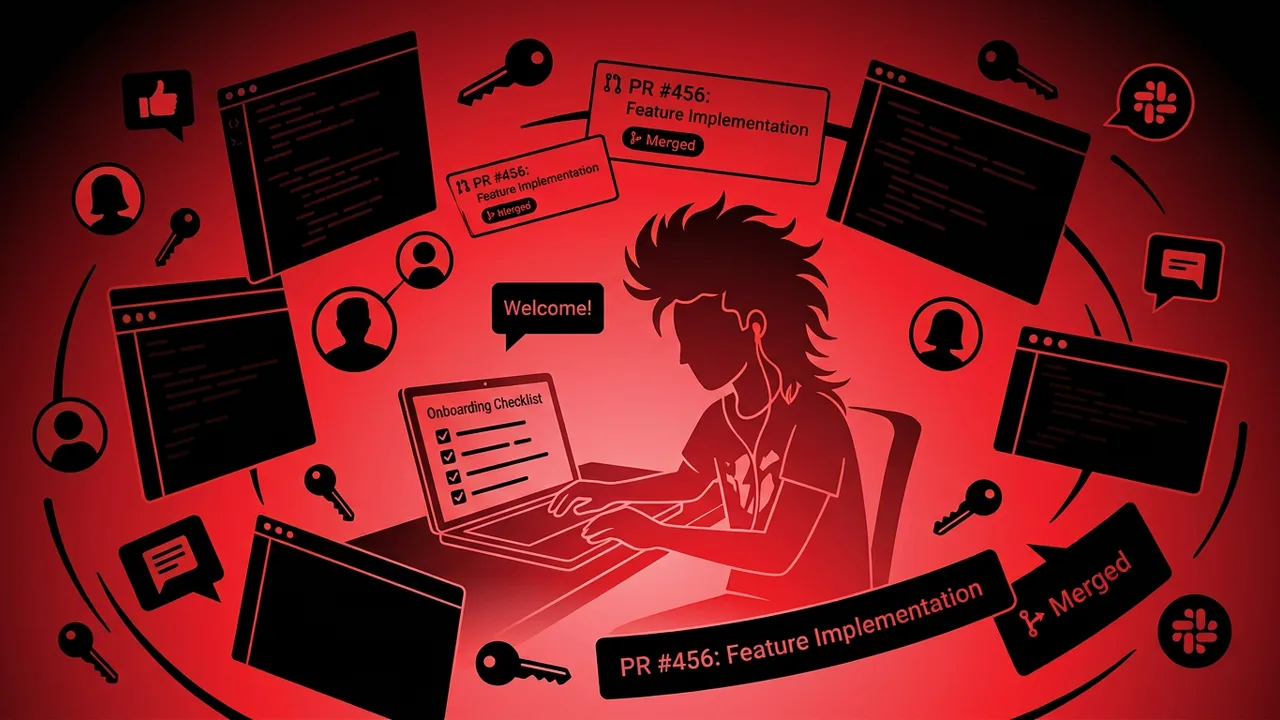
Remote onboarding for software engineers is where a team proves whether it actually knows how to operate remotely. The offer letter is signed. The laptop is in a box somewhere. The new developer is excited, nervous, and privately wondering one thing: am I going to be useful here, or am I going to spend three weeks begging for access?
That question matters more than most managers admit. A remote engineer cannot absorb context by overhearing conversations near the coffee machine. They cannot glance over at a senior developer and ask, "what does this service do?" They cannot read the room after a confusing architecture meeting. If your onboarding process is just a calendar full of Zoom calls and a stale wiki page, you are making them decode your company through fragments.
The best remote onboarding process does the opposite. It removes blockers before day one, gives the developer a map of the codebase, creates early human connection, and engineers a safe first contribution. It doesn't try to dump the entire company into their head. It creates momentum.
This guide gives you a 30-day remote software engineer onboarding checklist that works for engineering managers, tech leads, startup founders, and the new developers themselves. Use it to design a process that gets people shipping without pretending remote work is the same as office work with webcams.
1. Why Remote Developer Onboarding Breaks So Easily
Software engineer onboarding is already harder than normal employee onboarding because the work is buried under technical context. A new engineer needs access to source control, CI/CD, cloud accounts, test data, observability dashboards, product docs, architecture decisions, deployment workflows, team norms, and a bunch of unwritten rules nobody remembers are unwritten.
Remote work adds another layer. Every missing piece becomes slower to recover. In an office, a blocked developer can physically find someone. In a remote team, a blocked developer sends a Slack message, waits through time zones, gets half an answer, asks a follow-up, and loses half a day. Repeat that for repository access, local setup, flaky tests, unclear tickets, and ambiguous ownership, and you have a developer who looks "slow" when the process is actually broken.
Recent onboarding guides from Cortex, Enboarder, Full Scale, Turing, and Cycloid all point at the same pattern: successful onboarding needs clear owners, preboarding, environment setup, codebase orientation, communication norms, and measurable early outcomes. Cycloid frames the modern developer onboarding process as five stages: access provisioning, environment setup, codebase orientation, first task completion, and team integration. That is a useful lens because it forces you to stop treating onboarding as HR paperwork.
The remote version has three non-negotiables:
- Everything important must be explicit. Communication expectations, review standards, who owns what, where docs live, and how to ask for help cannot be tribal knowledge.
- Access must be ready before the start date. If the first day is spent waiting on GitHub, VPN, or cloud permissions, you have already taught the developer that your systems are chaotic.
- Human connection must be designed. Remote developers do not naturally bump into people. You have to create low-pressure introductions and recurring touchpoints without turning their calendar into a hostage situation.
The goal is not to make onboarding cute. The goal is to compress uncertainty. A new remote engineer should know what to do next, who can unblock them, and what "good" looks like at each stage.
2. Preboarding: The Work Starts Before Day One
The most important day of remote onboarding is not day one. It is the week before day one. That is when you either clear the runway or create a pile of avoidable blockers.
Preboarding begins as soon as the candidate accepts the offer. The manager should send a short welcome note that includes the start date, first-week shape, expected working hours, communication tools, and one clear reassurance: the first week is about context and setup, not proving worth through heroic output. This sounds small. It is not. New developers often overcompensate because they do not know what pace is expected.
Hardware should be ordered early enough to arrive before the start date. If the company ships laptops, monitors, security keys, or peripherals, assign one owner to track delivery. If the developer uses their own machine, send hardware requirements, OS assumptions, and security policies in advance. Nothing is more demoralizing than discovering on day one that the local stack only works on a different architecture or operating system.
Access provisioning should be treated like production reliability. Create a single checklist that covers SSO, email, Slack or Teams, GitHub or GitLab, issue tracker, documentation, password manager, VPN, cloud accounts, package registries, observability tools, design files, feature flag systems, and deployment dashboards. Each item needs an owner and a target completion date. "IT will handle it" is not an owner. Name the person or team.
Send the developer a lightweight preboarding packet. Do not send a 200-page wiki dump. Include:
- A first-week agenda with meetings, setup blocks, and expected outcomes.
- A team map showing the manager, buddy, tech lead, product partner, QA contact, and platform support channel.
- A product primer that explains what customers do, why the product matters, and which part of it the developer will touch first.
- A technical map with the main repositories, services, deployment flow, and local setup link.
- A help protocol explaining when to ask in public, when to DM, and what information to include when stuck.
That last point is huge. Remote developers waste time trying not to bother people. Tell them explicitly that asking for help is part of onboarding. Give them a rule like this: if you are blocked for 20 minutes during week one, post in the onboarding channel with what you tried, what happened, and what you need. That one rule can save days.
3. Day One: Welcome, Access, and a Tiny Win
Day one should not be a gauntlet. A remote developer's first day should end with three things: they feel welcomed, they can access the core systems, and they have completed one tiny useful action.
Start with a manager welcome call. Keep it human and practical. Explain the team's mission, the developer's role, the current priorities, and the plan for the first week. Then say the quiet part out loud: "You are not expected to understand everything today." Good managers reduce anxiety before it turns into performance theater.
Next, run an access verification session. Do not make the developer discover missing permissions one system at a time over the next week. Screen share if needed and confirm they can log into the core tools. Git provider, issue tracker, docs, Slack channels, package registry, CI, local environment instructions, and calendar should all be checked on day one. If something is missing, create the access request immediately and tag the owner.
Assign a buddy, not as a ceremonial checkbox, but as a real first line of support. The buddy should be close enough to the work to answer setup and codebase questions. They should also be given time for this role. A buddy who is buried under sprint work will become a bottleneck instead of a bridge.
Then create a tiny win. The first win might be editing a README, running the test suite, adding themselves to a team page, fixing a typo in internal docs, or opening a draft PR that proves their local environment works. This is not busywork if it validates the contribution path. The first commit teaches them how branches, pull requests, reviews, CI, merge permissions, and deployment expectations actually work.
A good day-one schedule looks like this: manager welcome, tool access check, team intro, setup block, buddy pairing session, independent break, tiny PR, end-of-day debrief. Notice what is missing: seven hours of meetings. Remote onboarding dies when you confuse calendar density with support.
4. Week One Checklist: Foundation, Context, and First PR
Week one is about reducing uncertainty. The new developer should not be judged by velocity yet. They should be judged by whether they can navigate the team, run the code, understand the first slice of the architecture, and ask useful questions.
By the end of week one, the developer should have:
- Completed environment setup and documented any outdated or confusing instructions they found.
- Joined the right communication channels and learned what belongs in standup, team chat, incident channels, and pull request comments.
- Had one architecture walkthrough focused on the part of the system they will touch first, not the entire platform history.
- Shadowed a code review so they can see team standards in action.
- Opened and merged one small pull request that exercises the real development workflow.
- Met the key humans they will interact with: manager, buddy, tech lead, product manager, designer or QA partner if relevant.
The architecture walkthrough should be recorded. Remote teams underestimate how valuable recorded context is. The developer will forget half of what they hear because the codebase is new. A recording lets them revisit the explanation when the code starts making sense. Pair the recording with a simple system map: frontend, backend services, databases, queues, third-party APIs, deploy pipeline, monitoring, and ownership boundaries.
Do not make the first PR too hard. The point is not to test whether the developer can survive ambiguity. The point is to prove the workflow works. A great first PR might improve setup documentation because the developer is the only person seeing the process with fresh eyes. Another good option is a low-risk bug with clear reproduction steps and tests already nearby.
End week one with a structured retro. Ask four questions: what is clear, what is confusing, what blocked you, and what would make next week easier? Then fix at least one thing they identify. That teaches the developer that feedback matters here, and it improves the onboarding process for the next person.
5. Weeks Two to Four: From Guided Tasks to Real Ownership
Weeks two through four should gradually shift the developer from guided context to real ownership. The mistake is either extreme: keeping them in passive onboarding mode for a month, or throwing them into a vague production problem before they understand the terrain.
In week two, assign a small but real ticket. It should touch production code, include a clear definition of done, and have a known reviewer. The developer should be encouraged to write down assumptions before coding. Remote work rewards written thinking. A short implementation note in the ticket or PR description helps reviewers catch misunderstanding early.
In week three, give them a slightly larger task that crosses one boundary: frontend to API, API to database, service to queue, or code to deployment. The goal is not complexity for its own sake. The goal is to build a mental model of how the system moves. Pair this with one deeper technical session: data model walkthrough, deployment walkthrough, incident review, domain model explanation, or test strategy discussion.
In week four, the developer should own a contained outcome. That might be a small feature, a bug cluster, a refactor with tests, or a support escalation. Ownership means they drive the work, communicate status, ask for help when needed, and close the loop after merge. They still need support, but they are no longer only observing.
Keep manager check-ins frequent but lighter. Week one might need daily check-ins. Week two can move to two or three. By week four, the standard one-on-one rhythm may be enough, with the buddy still available for codebase questions. The point is to avoid both neglect and micromanagement.
This is also where remote communication norms become real. Teach the developer how your team writes status updates. Show examples of good PR descriptions. Explain how decisions are captured. If your team uses async standups, demonstrate what a useful update looks like: yesterday, today, blockers, risk, and links. Do not assume people know your local dialect of remote work.
6. Codebase Orientation: Teach the Map, Not Every Street
New remote developers do not need a four-hour lecture on every service your company has ever built. They need a map. The map tells them where they are, where to look next, and which areas are dangerous.
Start with the product flow. What does the user do? Which system receives the request? Where does the data go? What happens asynchronously? What systems are customer-facing, internal, legacy, experimental, or high-risk? Tie code to customer value before diving into folder structure. Developers learn faster when they understand why the code exists.
Then explain the technical boundaries. Show the main repositories, service ownership, deploy cadence, branch strategy, test layers, and observability entry points. Give the developer a "when X breaks, look here" guide. When local tests fail, where do they look? When CI fails, who owns the runner? When staging is down, what dashboard matters? When a feature flag behaves strangely, who knows that system?
Context beats memorization. GitHub's developer experience research has repeatedly emphasized that codebase understanding and collaboration shape productivity. That matches what every senior engineer knows from experience: people are not slow because they cannot type code. They are slow because they do not know which code matters, what constraints are hidden, and which tradeoffs are acceptable.
A strong codebase orientation package includes:
- A system diagram that is honest enough to be useful and simple enough to remember.
- A glossary of product and technical terms that insiders use casually.
- Repository READMEs that actually run on a clean machine.
- A "first tickets" list labeled by difficulty and domain area.
- Recent architecture decisions so the developer does not relitigate old debates by accident.
If the developer finds a broken doc, let them fix it. Documentation work during onboarding is not a distraction. It is how you convert confusion into an asset.
7. Remote Communication Norms: Make the Invisible Rules Visible
Remote onboarding fails when the real rules are invisible. Every team has norms around response time, meetings, pull request comments, escalations, availability, and decision-making. If you do not explain them, the new engineer will guess. Guessing creates anxiety and weird behavior.
Write the norms down. How fast should people respond in Slack? Which channel is for urgent production issues? When is it okay to DM someone? What does "async by default" actually mean? Are people expected to be online during core hours? How should someone say they are blocked? When should a discussion move from chat to a document or call?
For pull requests, give examples. Show a strong PR description, a weak PR description, a helpful review comment, and an unhelpful review comment. Explain your review SLA. If reviews usually take one business day, say that. If small PRs should be under 300 lines, say that. If architectural changes need a design note first, say that before the new developer spends two days coding the wrong thing.
Remote teams also need decision hygiene. A decision made in a meeting is not real until it is written somewhere discoverable. That might be an ADR, a ticket comment, a project doc, or a Slack summary pinned to a channel. New developers suffer most when decisions live only in meetings they did not attend.
Finally, normalize public questions. A healthy onboarding channel lets new engineers ask basic questions without feeling exposed. Public questions help the next hire, reveal broken docs, and prevent the buddy from becoming a private help desk. The manager should model this by answering generously and thanking the developer when their question exposes an unclear process.
8. The Remote Developer Onboarding Checklist for Managers
Managers do not need a complicated onboarding ceremony. They need a repeatable checklist that removes ambiguity. Here is the practical version.
Before day one: confirm hardware, accounts, calendar invites, buddy assignment, first-week agenda, setup docs, and first ticket. Send a welcome note. Tell the team who is joining, what they will work on, and how to welcome them.
Day one: hold the welcome call, verify access, introduce the buddy, explain the first-week expectations, and make sure the developer gets one tiny win. End the day with a five-minute message or call asking what is still blocked.
Week one: prioritize setup, product context, architecture basics, team introductions, shadowing, and the first PR. Do not overload the calendar. Protect focus blocks. Ask for feedback on docs while the confusion is fresh.
Week two: assign a real but bounded ticket. Make the reviewer explicit. Ask the developer to write assumptions before implementation. Watch for silent blockers, especially in time zones where help is delayed.
Week three: expand scope across one system boundary. Introduce deployment, observability, support workflows, and incident history. Ask whether the developer understands how their work reaches customers.
Week four: give a contained ownership area and evaluate the onboarding process. What still feels unclear? Which docs lied? Which meetings helped? Which meetings wasted time? Turn those answers into process improvements.
The manager's job is not to spoon-feed every answer. The job is to create a path where the developer can become independent without falling into avoidable holes. That is the difference between support and dependency.
9. The Checklist for New Remote Software Engineers
If you are the developer joining a remote team, you are not powerless. A good company should onboard you well, but you can also make yourself easier to help and faster to trust.
First, keep an onboarding log. Write down what you tried, what worked, what broke, what terms you do not understand, and which docs are outdated. This log becomes your memory while everything is new. It also becomes valuable feedback for the team.
Second, ask better questions. Instead of "setup is broken," write: "I ran npm install on Node 22, got this error, tried clearing node_modules and checking the README, and I think the private package token may be missing. Who owns registry access?" That kind of question gets answered fast because it contains context.
Third, learn the communication system as deliberately as the codebase. Watch where decisions happen. Notice how strong engineers write PRs. Pay attention to how blockers are escalated. Remote career growth depends heavily on visible, useful communication. You do not need to be loud, but you do need to be legible.
Fourth, optimize for trust before brilliance. Ship a small clean PR. Respond well to review feedback. Document something you learned. Follow through on what you said you would do. That builds confidence much faster than trying to impress everyone with a huge risky change in week two.
Finally, schedule context, not just tasks. Ask your buddy or tech lead for a 30-minute walkthrough of the domain you are touching. Ask the product manager what customer pain the feature solves. Ask support what users complain about. The fastest remote developers are not the ones who memorize every file. They are the ones who quickly understand what matters.
10. How to Measure Whether Onboarding Is Working
You cannot improve remote onboarding if you only rely on vibes. Measure enough to find friction without turning humans into dashboards.
The simplest onboarding metrics are time to access, time to local environment, time to first PR, time to first merged PR, number of blockers in week one, review turnaround time, manager check-in completion, buddy check-in completion, and new hire confidence at days 7, 14, and 30. You do not need fancy tooling to start. A shared checklist and short pulse survey are enough.
Be careful with "time to productivity" as a blunt metric. A senior developer joining a tiny Rails app and a junior developer joining a distributed systems team will ramp differently. Measure the process more than the person. If every new hire waits two days for cloud access, the problem is not individual ability.
Use qualitative signals too. Can the developer explain the product area they work on? Do they know who owns adjacent systems? Are they asking increasingly specific questions? Are their PR descriptions improving? Do they know how to get help without private panic? Those signals tell you whether they are building real context.
A 30-day onboarding review should cover both performance and process. For the developer: what are you proud of, where do you still feel lost, what do you need next? For the manager: what expectations are clear, what progress is visible, and what support will change in month two? For the process: what should we fix before the next hire starts?
11. The 30-Day Remote Onboarding Playbook
If you only take one thing from this guide, take this: remote software engineer onboarding is not a welcome meeting. It is a designed ramp from uncertainty to ownership.
Before day one, remove access blockers, send the first-week map, assign a buddy, and prepare a small first task. On day one, welcome the developer, verify tools, explain expectations, and create a tiny win. In week one, focus on setup, codebase orientation, team norms, and a first PR. In weeks two and three, move into real bounded tasks and deeper system context. By week four, give the developer a contained ownership area and review both their progress and your onboarding process.
The process should feel calm, not soft. Clear, not bureaucratic. Human, not performative. A remote developer who knows where to find context, how to ask for help, and what good work looks like can move quickly. A remote developer left to decode everything alone will either slow down, burn out, or leave.
Build the onboarding process you wish you had when you joined your hardest team. Your future hires will feel the difference in their first week. Your current team will feel it in fewer interruptions, cleaner docs, faster first contributions, and less hidden anxiety. That is the real win.