Quick summary
34 data points on meeting load, context switching, focus time, remote collaboration, and what engineering teams can do about it
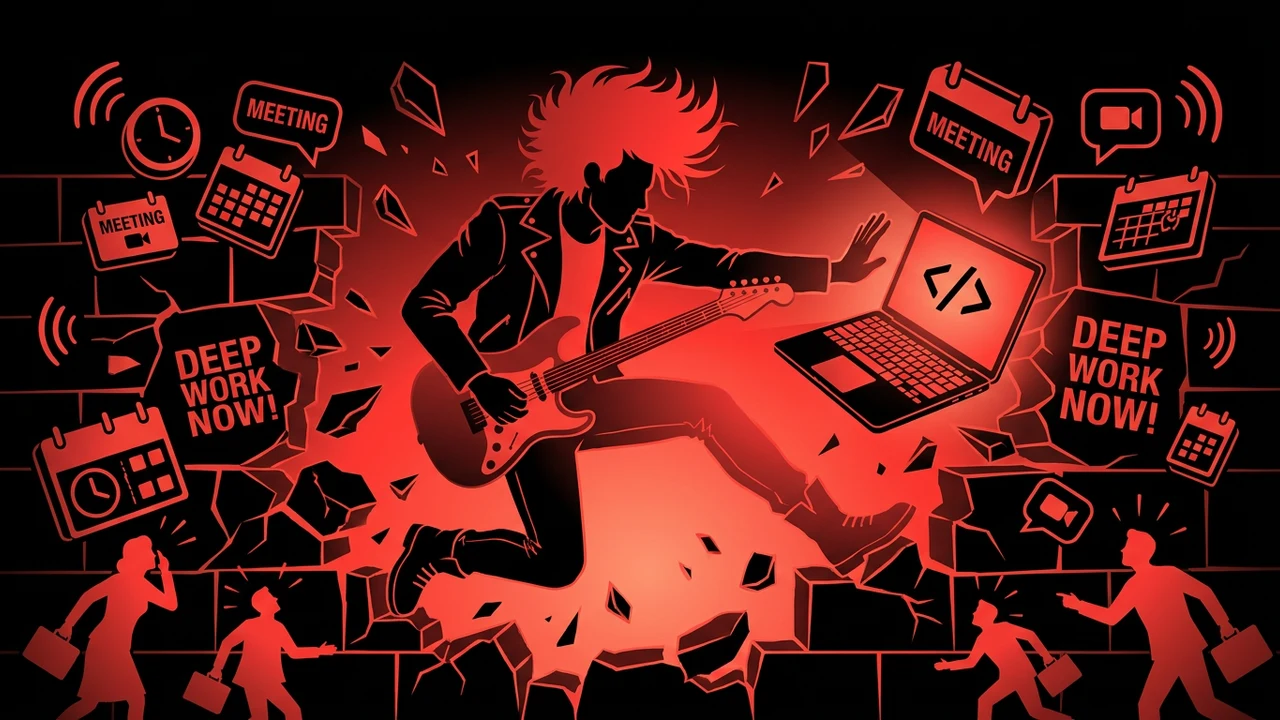
Meetings do not just take time away from software developers. They break the mental state required to solve hard problems.
That distinction matters. A 30-minute call can consume 30 minutes for a salesperson and half a morning for a programmer. The developer has to stop, unload a mental model of the system, attend the call, and then rebuild that model before useful work resumes. A calendar can look only half full while the workday is already shredded.
This resource collects 34 statistics and research findings about meeting load, communication time, interruptions, multitasking, and developer experience. The evidence comes from Microsoft, Atlassian, Asana, Stack Overflow, GitLab, the University of California, Irvine, and other published research. Some studies cover knowledge workers broadly, while others focus directly on developers. That difference is identified throughout the article.
The headline is simple: software teams do not have a meeting problem because developers dislike talking. They have a meeting problem when synchronous communication is allowed to destroy the focus blocks that engineering work needs.
1. Software Developer Meeting Statistics: Key Findings
Start with the numbers that should change how you plan an engineering week.
- 57% of the average Microsoft 365 workday is spent communicating, compared with 43% spent creating. The communication bucket includes meetings, email, and chat. Microsoft Work Trend Index
- 68% of workers say they do not have enough uninterrupted focus time during the workday. Microsoft Work Trend Index
- Inefficient meetings rank as the number one productivity disruptor, ahead of unclear goals, too many meetings, and uninspiring work. Microsoft Work Trend Index
- 30% of remote meetings involve multitasking, based on a large Microsoft analysis of meeting activity. Microsoft Research
- It takes about 23 minutes to return to an interrupted task in University of California, Irvine workplace research. UC Irvine interruption research
- 58% of the workday is consumed by work about work, such as coordination, status checking, tool switching, and unnecessary meetings. Asana Anatomy of Work
- 129 hours per employee are lost each year to unnecessary meetings, according to Asana's 2023 global study. Asana Anatomy of Work
- 50% of developers lose at least 10 hours each week to organizational inefficiencies, while 90% lose at least six hours. Atlassian State of Developer Experience 2025
Those numbers come from different populations and methods, so you should not stack them into one giant cost estimate. You should read them as converging evidence. Communication consumes more time than creation, focused work is scarce, and developers report losing a meaningful part of every week to friction outside the editor.
2. Developers Are Paid to Create, but Workdays Favor Communication
Microsoft analyzed activity across its productivity tools and found a 57-to-43 split between communication and creation. Meetings, email, and chat occupy the larger share. Documents, spreadsheets, and presentations make up the creation side. The dataset covers knowledge workers, not only engineers, but the implication for developers is sharp because programming is unusually dependent on sustained concentration. Microsoft Work Trend Index
The same Microsoft report found that the heaviest 25% of email users spend 8.8 hours per week on email, while the heaviest 25% of meeting users spend 7.5 hours per week in meetings. Those are separate top-quartile groups, so adding them together would be bad analysis. What the figures do show is that either channel can claim a full workday by itself. Microsoft Work Trend Index
Asana reaches a similar conclusion through employee surveys. Its Anatomy of Work research says 58% of time goes to work about work, leaving 33% for skilled work and 9% for strategy. For a 40-hour week, the 58% share equals 23.2 hours spent coordinating rather than doing the craft a person was hired to do. That calculation is ours, based on Asana's reported percentage. Asana Anatomy of Work
This is not an argument that communication is waste. Software is a team sport. Requirements, design reviews, incident coordination, mentoring, and customer feedback can save weeks of building the wrong thing. The failure is treating all communication as equally valuable. A decision meeting with the right four people may save a sprint. A status meeting with 14 silent attendees may simply convert salary into calendar occupancy.
The useful metric is not meeting hours alone. It is valuable decisions per synchronous hour. If a meeting produces a decision, assigns an owner, resolves a conflict, or creates shared understanding that writing could not create efficiently, it may be worth the interruption. If it only transfers information, an asynchronous update often preserves both the information and the focus block.
3. The Focus-Time Deficit Is an Engineering Risk
Sixty-eight percent of people say they lack enough uninterrupted focus time, according to Microsoft's 2023 Work Trend Index. The report also identifies inefficient meetings as the top productivity disruption. Too many meetings comes in third, which reveals an important nuance: quality and purpose are at least as important as quantity. Microsoft Work Trend Index
Developers need more than an empty rectangle on a calendar. They need enough time to load the problem into working memory, explore it, make a change, test it, and recover when the first approach fails. A one-hour opening between calls is not a one-hour coding block. It includes transition time on both ends, plus whatever attention remains stuck on the previous conversation.
Atlassian's 2025 developer experience research makes the cost more concrete. It reports that 50% of developers lose 10 or more hours each week to organizational inefficiencies. It also says 90% lose at least six hours per week. For a 500-developer organization, Atlassian estimates that this friction can approach $8 million in annual lost productivity. Atlassian State of Developer Experience 2025
Meetings are not the only source of that loss. Poor documentation, unclear ownership, fragmented tools, slow build systems, and vague requirements all contribute. In fact, blaming the calendar for every productivity issue lets bad engineering systems off the hook. Still, meetings amplify those problems when a team schedules calls to compensate for missing documentation and unclear decisions.
Think of focus time as production capacity. You would not randomly take a database offline six times per day and then complain about throughput. Yet many companies do the cognitive equivalent to engineers. They scatter recurring calls across every morning and afternoon, leaving no period long enough for deep work, then ask why cycle time is slow.
4. Context Switching Makes a 30-Minute Meeting Cost More Than 30 Minutes
The most cited interruption finding comes from Gloria Mark and researchers at the University of California, Irvine. Their field research found that workers took an average of 23 minutes and 15 seconds to return to the original task after an interruption. UC Irvine interruption research
That number is not a universal timer. A developer answering a simple message may recover faster. An engineer debugging a race condition may need much longer. The study also observed something that raw recovery time misses: people often switched to other tasks before returning. Interruption changes the sequence of work, not just its duration.
Microsoft later reported that the average employee was interrupted every two minutes by a meeting, email, or notification during core work hours, based on Microsoft 365 telemetry. The company also recorded 275 interruptions per day for the most interrupted users. Those figures count digital signals, not 275 full task switches, but they show the volume competing for attention. Microsoft Work Trend Index Special Report
For software work, context includes variable state, architecture assumptions, logs, test results, open files, and the reason an apparently obvious solution already failed. None of that fits neatly in a note you can reload instantly. The meeting invite says 30 minutes. The cognitive invoice arrives later.
A simple weekly calculation illustrates the risk. Five meetings that each trigger only 15 minutes of recovery create 75 minutes of hidden transition cost. If each recovery takes the UC Irvine average, the hidden cost reaches almost two hours. That is in addition to the meetings themselves. These are scenarios, not measured universal averages, but they show why looking only at calendar duration understates the effect.
The practical response is calendar batching. Put recurring meetings next to each other when possible. Create meeting-free half-days. Avoid placing a single call in the center of a large open block. The goal is not to remove human contact. It is to stop chopping a high-value cognitive resource into unusable pieces.
5. Meeting Multitasking Is a Signal, Not a Solution
A Microsoft Research study examining remote meeting behavior found that about 30% of meetings included multitasking. Email accounted for more than 40% of observed multitasking activity. Multitasking was more likely in longer meetings, larger meetings, recurring meetings, and meetings held in the morning. Microsoft Research
The researchers also found that multitasking increased when cameras and microphones were off. That does not prove that cameras cause attention. A camera-off meeting may simply be one where attendance is less necessary. The stronger conclusion is that meeting design predicts attention. When a call is large, long, and recurring, many attendees decide that something else deserves part of their brain.
Developers often defend multitasking as a way to recover wasted time. They answer Slack, review a pull request, or edit code while half-listening. That feels efficient. Usually it means both activities receive worse attention. The meeting still blocks deep work, while the coding task inherits partial concentration and greater error risk.
Multitasking can also expose an invitation problem. If six of ten attendees are doing email, the organizer should not ask how to force engagement. The better question is why those six people were required. A recording, decision log, or concise written summary may serve them better.
The Microsoft study offers a useful diagnostic. Look for recurring meetings with many attendees, long durations, and low participation. Those are the first candidates for cancellation, smaller invite lists, or asynchronous replacement. You do not need surveillance software. You need the courage to admit that a room full of muted people is not collaboration.
6. The Annual Cost of Unnecessary Meetings
Asana's 2023 Anatomy of Work report estimates that the average employee loses 129 hours per year to unnecessary meetings. Executives lose more than five workweeks per year to them. Asana Anatomy of Work
At 129 hours, one employee loses a little over three 40-hour weeks. A 20-person engineering group would lose 2,580 hours if it matched that average. At an illustrative loaded labor cost of $100 per hour, that would equal $258,000. The hours come from Asana; the team calculation is a transparent scenario, not a claim that every engineering group loses exactly that amount.
Salary cost is only the visible part. There is also delay cost. If a meeting pushes a release by a day, slows a security fix, or forces a senior engineer to postpone a code review, the business effect may exceed the wages spent on the call. The most expensive attendee often is not the person with the highest salary. It is the person whose interrupted work blocks five other people.
Meeting cost should therefore include four components: attendee time, preparation time, context recovery, and downstream delay. Most calendar analytics count only the first. That makes bad meetings look cheaper than they are.
This does not mean every recurring event is waste. Sprint planning can reduce ambiguity. An incident review can prevent a repeat failure. A one-on-one can retain a strong engineer. The test is whether the meeting produces an outcome worth more than its full cost. If the only output is that everyone heard the same update, publish the update.
7. Remote and Hybrid Teams Need Better Meeting Rules, Not More Meetings
Distributed work changes the economics of coordination. Stack Overflow's 2024 Developer Survey found that 38% of professional developers worked remotely, 42% worked in hybrid arrangements, and only about 20% worked primarily in person. Exact percentages vary by rounding and respondent group, but four out of five professional developers were outside a full-time office default. Stack Overflow Developer Survey 2024
That flexibility creates access to talent and gives developers control over their environment. It also tempts organizations to replace every hallway conversation with a scheduled call. The result can be a remote company that preserves the interruption pattern of an office and adds time-zone pain.
GitLab's Remote Work Report found that 33% of respondents identified meeting fatigue as a major challenge. It also found that 42% struggled with maintaining boundaries between work and home. These issues connect. A calendar that stretches across time zones can turn flexible work into permanent availability. GitLab Remote Work Report
Remote meetings need a higher bar because their hidden costs are not evenly distributed. A convenient 10 a.m. call for headquarters can land at dinner for one engineer and before sunrise for another. The people who absorb that cost are often least likely to challenge the invite.
Use rotating meeting times when no shared window exists. Record decisions, not just video. A two-hour recording is not documentation. Publish the decision, reasoning, owner, and next step in text so someone waking up six hours later can act without watching a movie about work.
8. Which Engineering Meetings Earn Their Place?
Good engineering organizations do not ban meetings. They separate high-bandwidth work from routine information transfer.
Incident response usually deserves real-time coordination because delay is expensive and facts change quickly. Design disputes may benefit from a short call after the options and tradeoffs are written down. One-on-ones create private space for feedback, career issues, and concerns that should not be handled in a ticket. Pairing sessions can solve an ambiguous technical problem faster than a long comment thread.
Status reporting, however, rarely requires everyone at the same time. Neither do first-pass document reviews, routine approvals, or announcements. Daily standups can be useful for small teams with real dependencies, but a round-robin recital to a manager is not a standup. It is a report that happens to interrupt everybody.
Microsoft found that inefficient meetings were the leading productivity disruption, while too many meetings ranked third. Microsoft Work Trend Index That gap suggests teams should improve purpose before chasing an arbitrary meeting quota.
Every invite should answer four questions before it lands: What decision must be made? Why does it require live interaction? Who is required for that decision? What preparation lets us finish sooner? If the organizer cannot answer those questions, the calendar event is not ready.
9. A Data-Informed Meeting Playbook for Engineering Managers
The fix is not complicated, but it requires managers to protect focus as aggressively as they protect deadlines.
- Measure fragmentation, not just hours. Four meetings grouped on Tuesday may be less damaging than four isolated meetings across four afternoons. Track the longest uninterrupted block available to each engineer.
- Create a synchronous budget. Start with a maximum for recurring team meetings, then make every new recurring invite replace or justify itself against that budget.
- Require an agenda and intended decision. No agenda means no obligation to attend. A meeting without a decision can still be useful, but the purpose must be explicit.
- Default optional attendees to async. Send them the written outcome. Do not use optional invites as political insurance.
- Batch ceremonies. Put planning, review, and retrospectives near one another when practical. Preserve larger blocks on the other days.
- End when the outcome is reached. A 45-minute calendar block is a ceiling, not a contract.
- Audit recurring meetings every quarter. Cancel first. Recreate only the meetings people can defend with a specific result.
- Publish decisions in writing. A decision that exists only in a call will create another call later.
Atlassian reports that half of developers lose at least 10 hours per week to organizational friction. Atlassian State of Developer Experience 2025 Reclaiming even two of those hours is meaningful. For a 10-person team, two hours per developer creates 20 additional hours of engineering capacity each week without hiring anybody.
Do not turn the playbook into another layer of process. The aim is fewer interruptions and clearer decisions. If the meeting policy takes three meetings to explain, start over.
10. What Individual Developers Can Do Without Becoming the Calendar Police
You may not control the company calendar, but you can change the way people experience working with you.
Write updates that answer the next question before somebody asks it. Include current state, blocker, owner, and next action. Make pull requests easy to review by explaining the problem, approach, risk, and test evidence. Record technical decisions where the next developer will look. Clear writing prevents meetings better than complaining about meetings.
Protect focus blocks visibly. Name them for the outcome, such as “payment retry implementation,” rather than “busy.” People are more likely to respect work they can understand. Batch your own office hours so teammates know when they can get quick help without interrupting random parts of the day.
When you receive a vague invite, ask a neutral question: “What decision should we leave with, and is there anything I should read first?” That improves the meeting even if it still happens. If your presence is only informational, offer to read the notes and respond asynchronously.
Do not hide during meetings and call it productivity. If you are required, participate. If you are not required, decline respectfully. Microsoft observed multitasking in roughly 30% of remote meetings, especially long, large, and recurring ones. Microsoft Research Silent multitasking preserves the broken invite. Honest feedback gives the organizer a chance to fix it.
Senior developers have extra responsibility here. Junior engineers copy the communication patterns they see. If every architectural choice happens in private calls, knowledge becomes status. If decisions are written down, the whole team gets smarter.
11. How to Measure Whether Meeting Changes Actually Work
A company can cut meeting hours and still make work worse. Teams might lose coordination, duplicate effort, or wait longer for decisions. Measure outcomes alongside calendar volume.
Track the median length of uninterrupted focus blocks, recurring meeting hours per engineer, invite acceptance rates, and the percentage of meetings with written outcomes. Then pair those signals with delivery measures such as pull request cycle time, deployment frequency, escaped defects, and developer-reported friction.
Survey data matters because calendar telemetry cannot tell you whether a meeting saved three days of rework. Ask a small set of repeatable questions each month: Did you have enough focus time? Which recurring meeting helped most? Which should disappear? Where did a missing conversation cause delay?
Run changes as experiments. Cancel one status meeting for four weeks and replace it with a structured update. Group ceremonies onto two afternoons. Add one meeting-free morning. Compare focus time and delivery signals before and after. A policy imposed everywhere at once produces opinions. A bounded experiment produces evidence.
Be careful with individual productivity scoring. Developer work is collaborative and uneven. Calendar time should never become a performance ranking. Use the data to improve the system, not to punish people whose roles require mentoring, incident response, or cross-team coordination.
12. Sources and Methodology
This page combines telemetry studies, employee surveys, developer surveys, and workplace field research. Figures are attributed inline so readers can distinguish a measured behavior from a self-reported opinion. Knowledge-worker findings are not presented as developer-only results. Derived examples are labeled as calculations or scenarios.
- Microsoft Work Trend Index 2023: Microsoft 365 telemetry plus a survey of 31,000 people in 31 countries.
- Microsoft Work Trend Index Special Report: digital activity and interruption patterns.
- Microsoft Research remote meeting study: large-scale analysis of multitasking during remote meetings.
- Asana Anatomy of Work Global Index 2023: global survey data on work about work and unnecessary meetings.
- Atlassian State of Developer Experience 2025: survey of 3,500 developers and managers with Wakefield Research.
- University of California, Irvine interruption research: workplace observation research led by Gloria Mark.
- Stack Overflow Developer Survey 2024: work-location data from professional developers.
- GitLab Remote Work Report 2021: survey findings on meeting fatigue and work boundaries.
- Nature Human Behaviour collaboration study: research on how firm-wide remote work changed communication patterns.
- Harvard Business Review collaborative overload research: analysis of collaboration demands on knowledge workers.
- Microsoft Research on remote collaboration: study of communication changes among information workers.
- ACM Queue research on developer productivity: discussion of developer productivity measurement and the SPACE framework.
Reports use different samples, dates, definitions, and collection methods. Meeting time in Microsoft 365 is not directly comparable with a self-reported Asana survey. The figures should be used as directional benchmarks, not as a single universal baseline for every engineering organization.
13. The Bottom Line
Developers do not need silence all week. They need intentional collaboration and enough uninterrupted time to turn that collaboration into working software.
The strongest evidence points in the same direction. Communication already occupies more of the average knowledge-worker day than creation. More than two-thirds of workers say focus time is insufficient. Developers report losing six to 10 hours per week to organizational friction. Remote meeting research finds multitasking in roughly three out of 10 calls. Unnecessary meetings consume the equivalent of several workweeks each year.
The answer is not a dramatic no-meeting rule. It is a higher standard for synchronous time: fewer required attendees, clearer decisions, written context, batched schedules, and recurring events that must repeatedly earn their place.
Your engineers' calendars are part of your production system. Design them like it.
Explore more on