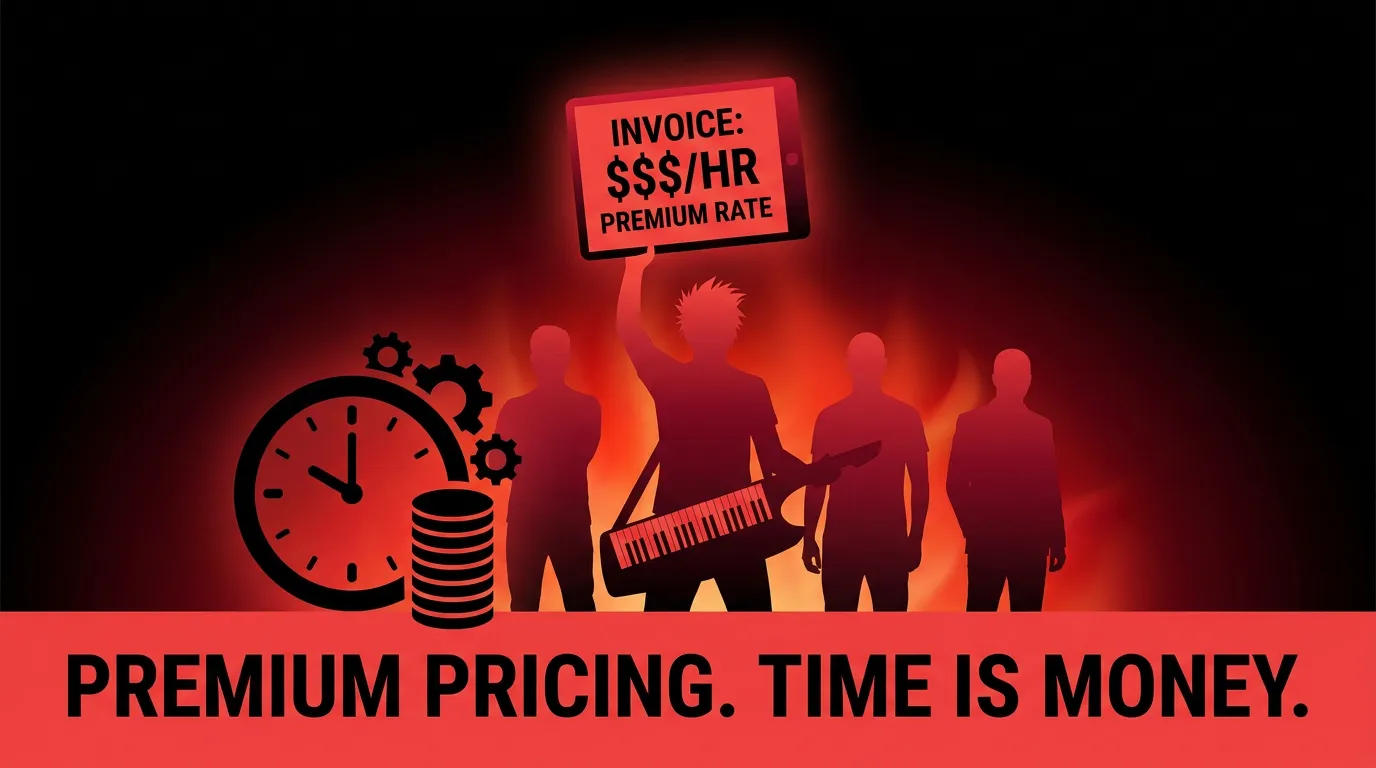
I'm John Sonmez, and I'll be blunt. If you came here for one number, here it is: most independent AI consultants charge $150 to $350 an hour, junior people land around $100 to $150, senior specialists hit $300 to $500, and a handful of enterprise AI engineers are now billing $900 an hour as consultants (Fortune, 2025). There. You have the answer. Now let me ruin it for you, because the hourly number is the worst thing you can build your income on. The second a client knows your hourly rate, two bad things happen at once. You've capped what you can earn, and you've handed them a stopwatch to police your work. And here's the part nobody selling you a rate table will admit: AI now does in twenty minutes what used to bill for four hours, so every year you get better, hourly quietly pays you less. The people pulling the top of these ranges aren't good at hourly. They sell a deployed outcome and price off what fixing the problem is worth. If you want the full climb from your first paid engagement to a $300-plus specialist rate, that's what the AI consultant career path is built to walk you through. This page is about getting your pricing right so you actually get there.
1. The Real AI Consultant Hourly Rate Ranges in 2026 (No Hand-Waving)
Let's do the honest table first, because that's what you searched for and you deserve real numbers, not mush. By experience, AI consultant hourly rates break down roughly like this: junior or entry-level with zero to three years runs $100 to $150 an hour. Mid-level with three to seven years runs $150 to $300. Senior consultants with seven-plus years run $300 to $500 (Leanware, 2026). Above that sits an elite tier where enterprise AI engineers deployed as consultants are commanding $600 to $900-plus.
Who you are changes the number as much as how good you are. A solo freelance AI consultant typically charges $150 to $350 an hour and lands monthly retainers between $2,000 and $10,000 (Stack, 2026). A boutique AI agency runs higher, roughly $250 to $450, because they're carrying overhead. And the Big Four and strategy firms bill $350 to $600-plus an hour, stacking a 20 to 40 percent agency premium on top of the work itself. Specialized machine learning consultants and Ph.D.-level freelancers can command $250 to $500 an hour for the hard modeling work (Opinosis Analytics, 2026), and practitioners on r/MachineLearning report $150 to $250 an hour when they bring expertise a company specifically wants (Reddit, 2024).
Now, one clarification the salary-aggregator sites get wrong constantly. There's a difference between the cost side, what a buyer pays a consultant, and the salary side, what a full-time W-2 person earns. ZipRecruiter pegs the average salaried AI Consultant role at about $86,430 a year, roughly $41.55 an hour (ZipRecruiter, 2026), and Glassdoor reports $208,513 a year (Glassdoor, 2026). Those are employee numbers. They are not what an independent charges. Your day rate and your project price are the real number for you, and they sit far above any W-2 figure. Hold onto that gap, because I'm about to show you why it exists.
2. Why the $900-an-Hour AI Consultants Don't Actually Sell Hours
Here's the story that should reframe everything. In September 2025, Fortune reported that PromptQL, built by the San Francisco developer-tooling company Hasura, pays its AI engineers $900 an hour to work as consultants building and deploying AI agents on enterprise data (Fortune, 2025). Nine hundred dollars an hour. That's above what traditional Big Four consulting partners earn, which Oana Iordachescu of Deep Tech Recruitment pegged at $400 to $600 an hour (Fortune, 2025). Think about that. A software engineer is out-earning a McKinsey partner per hour. And PromptQL's cofounder Tanmai Gopal said the rate feels like they should be raising it, because clients aren't pushing back.
Why? Because these engineers don't advise. They execute. They build the pipelines, debug the models, ship the agents. As Iordachescu put it, they don't just advise, they execute. That's the difference between a $200 PowerPoint hour and a $900 deployed-outcome hour. The premium is failure insurance. An MIT Media Lab study found that 95 percent of enterprise generative AI pilots delivered no measurable return, despite $30 to $40 billion in enterprise spending, and blamed a learning gap, not the models (MIT, via Fortune, 2025). Jim Johnson at AnswerRocket told Fortune the $900 rate makes perfect sense because companies are buying insurance against joining that 95 percent failure statistic.
So sit with the lesson. Nobody is auditing whether those engineers worked exactly sixty minutes. The $900 isn't a time charge. It's a value signal. The client is buying a deployed result that lands them in the working 5 percent. Your rate is a function of how much the problem is worth to the client, not your years of experience and definitely not your cost of living. Get that backward and you'll undercharge for the rest of your career.
3. The Four Ways to Charge: Hourly, Project, Retainer, Value-Based
There are exactly four pricing models, and they are not equal. Hourly, at $100 to $500-plus, has one honest use: exploratory work with genuinely undefined scope, or a quick technical assessment where nobody can yet say what the engagement is. Everywhere else, hourly punishes you for getting faster. You spent five years learning to solve in an hour what used to take a day, and hourly billing thanks you by cutting your invoice by 87 percent. That's insane, and AI tooling makes it worse every quarter.
Project, or fixed-fee, is where most of your money should live. Small strategy assessments and pilots run $5,000 to $25,000. Mid-size builds run $25,000 to $100,000. Enterprise-wide implementations run $100,000 to $500,000-plus (Leanware, 2026). The client gets budget certainty, and you keep every dollar of efficiency you create. The catch: project pricing only works with a brutally tight statement of work. Sloppy scope is how fixed-fee deals turn into unpaid marathons.
Retainers are for proven relationships, never a cold open. Light advisory runs $2,000 to $5,000 a month, standard support $5,000 to $15,000, and a full-service partnership $15,000 to $50,000-plus (Leanware, 2026). They're ideal for ongoing agent monitoring once a client has already seen you deliver. The fourth model, value-based pricing, is the only one where AI making you faster increases your pay instead of cutting it, because you charge a slice of the savings or revenue you create. Alan Weiss, who wrote the book on value-based fees, argues time-based billing is an ethical conflict of interest and that consultants who price off value earn far more than hourly billing ever would. He's right.
AI is making raw coding skill cheap, and the buyer knows it. What justifies a top rate now is a name clients already trust before the first call. The free 5-day Rockstar Engineer Blueprint from John Sonmez shows you how to get known so the right clients come looking for you.
Get the Free Course4. How to Actually Set Your Number (The Math Nobody Shows You)
First, kill the amateur formula. You've seen it: take the annual income you need, divide by your available billable hours, and call that your hourly rate. That math anchors your price to your costs instead of the client's outcome. It's how you end up charging $90 an hour while delivering a result worth six figures to the buyer. Burn it.
If you must start from a floor, use the 2-5x rule. A freelancer charges two to five times what the equivalent full-time employee costs the company. That markup isn't greed, it's economics. It covers self-employment tax, the benefits you don't get, the unbillable hours you spend selling, your tools and compute, and the premium clients pay for on-demand expertise they can fire the second the project ends. Reality-check that floor against the market: BLS-derived data put the median AI consultant at about $70 an hour in 2023, with the lowest earners near $39 (Franklin University, 2023). Notice how far real consulting prices sit above that salary-adjacent number. The gap is the opportunity.
Then throw the floor away and price back from value, which is how the people at the top actually do it. Start with what solving the problem is worth to the client. A deployed support agent that cuts ticket volume 40 percent might save a company $800,000 a year. Price the engagement at roughly 10 to 20 percent of that value, and you've quoted $80,000 to $160,000 for work you can deliver in weeks. The client says yes because they keep 80 to 90 percent of the upside. You say yes because no hourly rate on earth gets you there. That's the whole game.
5. Specialization Is the Whole Game: Generalists Compete on Price
Here's a rule that holds in every market: generalists compete on price, specialists name their price. Niche AI skills carry a 20 to 30 percent premium over generic work. Generative AI, RAG pipelines, multi-agent systems, reinforcement learning, computer vision, and NLP all command the top of every range, because few people can actually ship them and demand is brutal.
Stack domain expertise on top and the premium compounds. Healthcare AI, fintech AI, legal AI: each adds another layer, because deep domain knowledge shortens time-to-value and de-risks the project for the buyer. A consultant who already understands HIPAA or trade-settlement workflows doesn't need three months to learn the business. That's worth real money to a nervous buyer staring at the 95 percent failure rate. Pedigree works the same way. Ex-FAANG engineers and ex-McKinsey or Deloitte consultants charge more because the credential signals both technical and business depth before the first meeting even starts. Heather Murray runs AI adoption workshops for government agencies and businesses and reportedly earns well over $500 an hour effective, because productized training built on a sharp niche out-earns generic hourly consulting.
So here's the directive, and I mean it: stop branding yourself an AI consultant. That phrase is a commodity. It tells the buyer nothing and invites them to compare you on price. The more specific your promise, the easier the premium. Don't say I do AI. Say I cut your support ticket volume 40 percent with a deployed agent, in 60 days. One of those gets haggled. The other gets hired. If you want the structured path to choosing a niche and building a deployed-outcome portfolio that justifies a premium, that's exactly what the AI consultant career path lays out step by step.
The consultants commanding $300, $500, even $900 an hour all built one thing first: a name clients already trust. The free Rockstar Engineer Blueprint is a 5-day course from John Sonmez on getting known so the best clients and offers come to you, instead of you competing on rate.
Get the Free Course6. What Drives Your Rate Up or Down (Geography, Scope, Risk)
A few real-world forces move your number, and you should know them cold. Geography still matters even in a remote world. The SF Bay Area runs roughly 40 to 60 percent above the national average. The Midwest sits well below. Offshore and nearshore talent in Latin America and Eastern Europe lands 40 to 70 percent under US rates, which is both your competition and, if you're smart about positioning, irrelevant to you, because nobody buying a deployed outcome shops on geography alone.
Scope creep is the silent rate-killer, and it wrecks hourly and fixed deals alike. An ambiguous statement of work is where the disputes come from, and disputes don't just cost money, they poison the relationship and kill the referral. Write the SOW like a lawyer wrote it for you. Then there are the hidden costs everyone forgets until the invoice: cloud compute, data labeling, third-party API fees, compliance and audit. Quote those as separate line items, not buried inside one number, so a $40,000 project doesn't quietly become a $52,000 reality you eat.
And then the tailwind, which is the part that should make you raise prices, not defend them. The AI consulting market is in the low-to-mid teens of billions of dollars in 2026 and growing more than 20 percent a year. BCG surveyed 2,360 executives, including 640 CEOs, and found companies plan to nearly double AI spending in 2026 to about 1.7 percent of revenue, up from roughly 0.8 percent in 2025 (BCG AI Radar 2026). When the buyer's budget is doubling and supply of people who can actually ship is flat, the correct move is to charge more, not to discount your way into a deal you'll resent.
7. How to Move a Client From Hourly to Value Without Losing the Deal
You'll get the objection: why not just bill hourly? Address it head-on, and don't be cagey. Hourly creates a conflict of interest. You profit by being slow. They pay more when you're worse. Value-based pricing flips that, so your pay rises with their result. Most clients have never had anyone say that out loud, and saying it builds trust faster than any pitch deck.
Use the staircase. Open with a small paid Discovery or Strategy phase, $1,500 to $3,000, where you diagnose the problem and quantify what fixing it is worth. That paid phase does two jobs: it filters out tire-kickers, and it gives you the number you'll price the real engagement against. Then scope the implementation as a fixed project tied to that value. Then, once you've delivered and they've seen it work, convert them to a retainer for ongoing monitoring. Each step earns the right to the next. Nobody starts at the top of the staircase, and you should never lead with a retainer to a stranger.
When the fee objection comes, and it will, handle it by raising perceived value, never by discounting. The moment you drop your price, you confirm the work was overpriced and you train the client to push again. Buyers genuinely believe they get what they pay for. It's the same psychology that lets Rolex and McKinsey charge what they charge. So stop quoting a rate and start quoting an outcome plus a price tied to it. The client stops counting your hours the instant the conversation is about their money instead of your time. That single shift is worth more than any rate increase you'll ever negotiate.
8. Turning a Rate Into a Career (Where This Actually Leads)
Step back and see the whole board. The hourly rate is the entry point, not the destination. The real money is in productized offers that decouple your income from your hours: workshops at $5,000 a day, fixed implementations priced off value, retainers that pay you while you sleep. Rob Howard, an AI consultant Fortune cited, said he wasn't surprised by mind-blowing numbers like $900 an hour, and his students have run two-day AI bootcamps netting $400 to $500 an hour effective. That's productization. That's the climb.
So treat this as a deliberate path, not a lottery ticket. Skills first, because you can't fake a deployed outcome. A portfolio of real, shipped results second, because that's what justifies the premium and gets you recruited instead of bidding. A sharp specialization and a value-based pricing model third, because that's what turns a freelancer who's busy into a consultant who's wealthy. Do them out of order and you'll stay stuck billing $120 an hour and wondering why.
And the demand has never been more in your favor. BCG found 72 percent of CEOs now say they are the main decision-makers on AI, twice the share of the year before, and 94 percent say they'll keep investing in AI at current or higher levels even if it doesn't pay off within a year (BCG AI Radar 2026). The person writing the check is the CEO, the budget is doubling, and they're committed even through failure. The buyer for premium AI help has never been more motivated. If you want the full roadmap from your first paid engagement to a $300-plus-an-hour specialist, including how to choose a niche, build the portfolio, and price every engagement, that's exactly what the AI consultant career path is built to give you.