I'm John Sonmez, and I'll give you the answer before the first ad break. No, software engineering is not dead. The Bureau of Labor Statistics still projects 15% growth for software developers from 2024 to 2034, roughly five times the 3% average for all jobs, with around 129,200 openings a year and about 1.7 million developer jobs already on the books (BLS, 2025). That is not a dying field. That is a growing one.
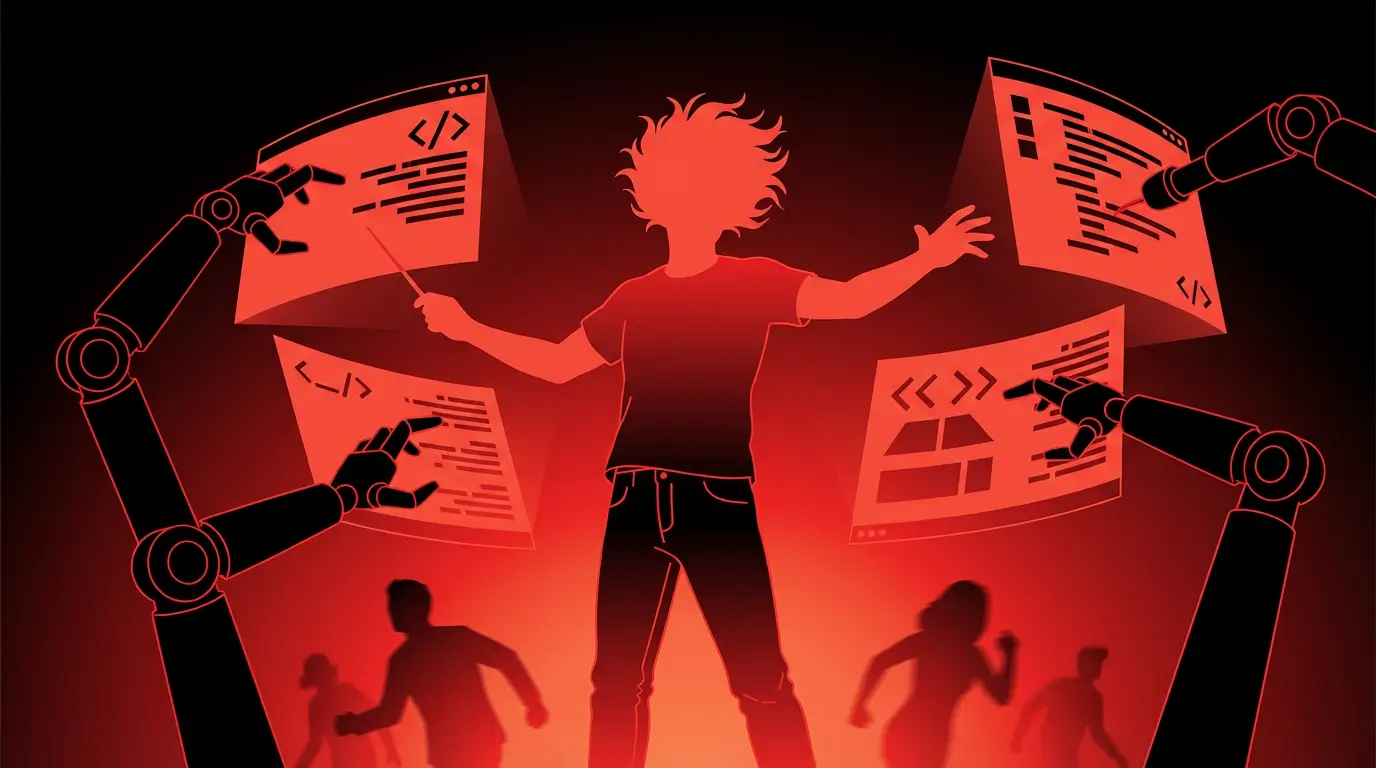
But I'm not going to lie to you either. Something is dying, and if you're the one standing on it, the technicality won't help you. The bottom rung is on fire. The version of this job where you memorize syntax, crank out CRUD endpoints, and turn well-specified Jira tickets into code is the exact tier AI eats first. The center collapsed. The value moved up to the people who direct AI, own the architecture, and know when the machine is confidently wrong.
So here's the self-selector, and I mean it. If you came here to feel better, to read a few comforting paragraphs and close the tab, you can stop now. The headline already gave you the dopamine. But if you came here to actually change your situation, then reading 2,500 words about whether the field is dead is a waste of your afternoon. The real move is to climb to the tier where demand is rising instead of falling, and that's exactly what the AI engineer career path is built to do. Start there. Then come back and finish this if you still want the full picture.
1. Short Answer: The Field Isn't Dead, But a Tier of It Is
The question itself is wrong, and that's why every Quora thread and Substack hot take keeps botching the answer. The internet keeps asking "is software engineering dead" as if engineering were one thing that lives or dies as a block. It isn't. The honest question is "which kind of engineer is dead," and once you ask it that way the data snaps into focus.
What's dying is the part of the job that was never really the job. Typing. Boilerplate. The mechanical translation of a tight spec into syntax. That's the tier where a junior used to earn their keep, and it's the tier an AI coding agent now handles in seconds. What's getting more valuable is everything that was always the actual work: deciding what to build, why, how the pieces fit, and whether the thing the machine just generated is sound or garbage dressed up to look sound.
"Software engineering is dead" is what you say when you mistook typing code for the job. The typing is dying. The engineering is getting more valuable by the month. So no, don't flee the field. The smart move is the opposite of fleeing: climb to the AI-engineer tier where the demand curve is going up while the CRUD jobs evaporate underneath it.
2. The Data That Scared Everyone: The Entry-Level Bloodbath Is Real
I'm not going to soft-pedal the scary part, because the doom isn't pulled out of thin air. The data for new grads genuinely looks rough, and pretending otherwise just makes you sound like every AI-tooling blog with something to sell.
The Stanford "Canaries in the Coal Mine" study is the one that lit the fuse, and it's not vibes. It's real ADP payroll microdata covering millions of workers. It found that early-career workers aged 22 to 25 in the most AI-exposed jobs, software development very much included, saw a relative employment decline of roughly 13% since generative AI spread, while older and more experienced workers in the same fields held steady or grew (Stanford, 2025). The youngest software developers specifically have been reported sitting around 20% below their late-2022 peak. Read that again. Same field. Opposite outcomes depending on where you sit on the ladder.
It gets worse before it gets better. As of July 2025, U.S. tech job postings on Indeed were 36% below their February 2020 level, and postings for "software engineer" specifically were down 49% versus early 2020 (Indeed Hiring Lab, 2025). On the new-grad front, Big Tech hiring of new graduates is down more than 50% since 2019, and recent grads now make up just about 7% of hires at major tech companies (SignalFire, 2025).
Now here's the part the doomers always skip. This isn't 100% AI. The zero-interest-rate party ended, companies massively over-hired in 2021 and 2022, and return-to-office mandates all landed before AI coding tools were even any good. AI didn't start the fire. It accelerated a correction that was already underway. That distinction matters, because if you blame the whole thing on AI you'll draw exactly the wrong conclusion about what comes next.
3. Why the Death Narrative Is Wrong: The AI Trust Gap
Here's the thing that should change your mind, and it comes straight from the people actually using these tools all day. If AI were really replacing engineers, the engineers using it would be the first to tell you. They're saying the opposite.
Stack Overflow's 2025 Developer Survey, with over 49,000 respondents across 177 countries, found that 84% of developers use or plan to use AI tools, up from 76% the year before. Adoption is nearly universal. But only 33% trust the accuracy of what the AI produces, while 46% actively distrust it (Stack Overflow, 2025). Sit with that gap. Almost everyone uses it. Almost nobody trusts it.
And here's the killer stat, the single most underused proof point in this whole debate: 66% of developers say their number one frustration is "AI solutions that are almost right, but not quite." Almost right. The most dangerous kind of wrong, because it looks done. Someone has to catch it, and that someone has a job.
The benchmarks back this up once you stop reading the press releases. The top AI models hit around 74% on SWE-bench Verified, which sounds terrifying until you learn that on the harder, contamination-resistant SWE-Bench Pro set, the same class of models collapses to around 23% (Scale AI, 2025). "Almost right" does not ship to production on its own. Every abstraction is leaky, and somebody has to know what's underneath when the AI writes a confident bug into your auth layer. That somebody is an engineer. That's the whole argument.
AI is making raw coding cheap, so "almost right, but not quite" output is now something every developer can produce. What it can't hand you is a name people already trust when the pressure is on. The free Rockstar Engineer Blueprint is a 5-day email course on becoming the developer your industry knows, so the best jobs and offers come looking for you instead of the other way around.
Get the Free Course4. Seniority-Biased Change: Hire Seniors, Automate Juniors
There's a name for what's actually happening, and it's not "the death of software engineering." Economists call it seniority-biased technological change. AI multiplies the engineers who already have judgment, and it puts a drag on the juniors who can't yet steer it, verify it, or wire its output into a real system without breaking three other things.
The math employers are running is brutal but simple. A senior with AI out-produces a senior plus a junior. So when the budget gets tight, the junior gets cut, not the senior. This isn't a feeling. SignalFire found that 37% of managers said they'd rather use AI than hire a Gen Z employee (SignalFire, 2025). That's a measured number, and it's ugly if you're the Gen Z hire on the wrong side of it.
Naval Ravikant put the flip side of this bluntly on X in 2025. Asked whether traditional software engineering was dead, his answer was "absolutely not." Engineers who think in code, he argued, are now among the highest-output people on earth, precisely because every abstraction is leaky and someone has to plug the bugs AI keeps introducing (Naval Ravikant, 2025). The advantage didn't disappear. It concentrated. It flowed away from the people who could only produce code and toward the people who can decide whether the code is correct.
So when you read "AI is replacing developers," translate it. AI is replacing one specific behavior: producing code from a spec without judgment. If that was your entire value, yes, you're exposed. If your value is the judgment, you just got a multiplier strapped to your back.
5. Coding Was Never the Hard Part
Let me say the contrarian thing out loud, because almost nobody in this debate will. Writing code was always the easy 20% of the job. It was the part you could automate in your head once you'd done it enough. The hard 80% was always somewhere else: figuring out the requirements, handling the ambiguity, designing the system, weighing the tradeoffs, reasoning about security, and talking to humans who don't actually know what they want and won't until you build the wrong thing first.
Addy Osmani, who's spent 14-plus years at Google and is now a Director at Google Cloud AI, surfaced the sharpest line in this whole debate, from a senior engineer he quotes. "The best software engineers won't be the fastest coders," that engineer put it, "but those who know when to distrust AI" (Addy Osmani, 2025). Read that carefully, because it's the opposite of what the panic says. The skill floor is rising, not falling. Knowing when to distrust the machine is a harder skill than typing fast, not an easier one.
This is exactly what you watch happen in practice with any AI coding agent. It gets you 70% of the way through a contained task, fast, and then it stalls on the part that requires taste. Is this architecturally sound? Will this abstraction hold when the requirements shift in three months? Does this error handling cover the failure modes that actually happen at 2 a.m., or only the ones in the happy-path demo? The AI doesn't know. It can't know. It has no skin in the production incident.
So here's the translation for you. If your whole value was turning a ticket into syntax, the market is telling you something you need to hear. But if your value is deciding what to build and why, and catching the place where the machine is lying with total confidence, you didn't lose your job. You got a 10x tool and a thinner field of competition.
6. The Numbers That Contradict the Doom (and the Nuance Doomers Skip)
Now let me show you the data the viral charts crop out, because the full picture is genuinely contradictory and the contradiction is the story.
Take the "CS grads can't find work" panic. It's real, but it's misread. The New York Fed puts recent computer science grad unemployment at around 6.1%, and computer engineering at 7.5%, versus about 5.7% for all recent grads (NY Fed, 2025). Elevated, yes. Catastrophic, no. And here's the stat the doom threads never post: CS has one of the lowest underemployment rates of any major, around 16.5% versus roughly 42% across all degrees, and around 90% of recent CS grads are employed. When a CS grad lands a job, it's overwhelmingly a real, degree-level role that pays near a six-figure median. The problem isn't that the degree is worthless. The problem is that "apply to 500 jobs and coast" stopped working.
Then zoom out to the globe, where the story isn't shrinking at all. GitHub passed 100 million developers in early 2023 and blew past 180 million by 2025 (GitHub Octoverse, 2025), with more than 5.2 billion contributions to over 518 million projects and 137,000 new public generative-AI projects in 2024 alone (GitHub Octoverse, 2024). A new developer joins roughly every second. That is not the signature of a dying profession.
And the layoffs, the thing everyone screenshots? Layoffs.fyi recorded about 152,000 tech layoffs across 551 companies in 2024 and around 124,000 across 269 companies in 2025, the lowest annual total since 2022 (Layoffs.fyi, 2025). The bleeding is slowing, not accelerating. Both things are true at once: a soft U.S. entry-level market sitting on top of strong, long-term, global demand. If you only quote one half, you get a headline. If you quote both, you get the truth.
The bottom rung is being automated, but the developers rising above it all did one thing first: they got known. When AI makes everyone's code look the same, the one who gets the job and the raise is the one people recognize. The free 5-day Rockstar Engineer Blueprint from John Sonmez shows you how to become the developer your industry knows by name.
Get the Free Course7. The Pipeline Problem: Who Trains the Next Senior?
There's a second-order effect here that almost nobody talks about, and it's the one that should worry the companies more than the workers. If you automate away every junior, you destroy the training ground that produces seniors. You can't have a senior engineer who was never a junior. The Communications of the ACM made exactly this argument: the talent pipeline collapses without deliberate early-career hiring, and the industry is quietly sawing off the branch it sits on.
That's the company's problem to solve, and some of them will, with mentor and preceptor programs that protect a few junior slots on purpose. But you can't wait around for that. So here's the move for you if you're trying to break in right now: stop positioning yourself as "a junior who writes code." That's the exact profile getting automated. Position yourself as "one person plus AI who ships like a small team."
Build real projects. Contribute to open source where the work is public and verifiable. Be able to explain every design decision you made and why you rejected the alternatives. Don't compete for the doomed bottom rung. Skip it.
And if you think automation kills a role permanently, remember the ATM. When the cash machine arrived, everyone declared the bank teller dead. Instead, U.S. teller jobs roughly doubled, from around 300,000 in 1970 to about 600,000 by 2010, because ATMs made branches cheaper to run, so banks opened more of them, and the teller's role moved up-value into relationship and sales work. The mechanical task got automated. The job moved up. Same pattern. Again.
8. What to Actually Do: Climb to the Tier AI Can't Reach
Alright. Enough diagnosis. Here's the prescription, and it's the same one I'd give my own kid.
Stop optimizing for the layer that's being automated. Every hour you spend getting faster at producing boilerplate is an hour invested in the one skill the machine already beat you at. Pour that time into the things AI stalls on instead: architecture, system design, debugging under uncertainty, and the judgment to smell when the AI is lying to you.
Become the person who directs AI rather than the person AI replaces. That's not a metaphor, it's a literal job title. It's the AI-engineer role, and it's the one corner of tech where postings and pay are rising while CRUD jobs disappear. The concrete skill stack is learnable: read and review code faster than you write it, own the last 30% the AI can't finish, learn evals and prompting and agent orchestration, and build real domain depth so you understand the problem, not just the syntax.
The engineers thriving in 2026 aren't down in the pit fighting an army of applicants and an AI coding agent for the bottom rung. They jumped. They climbed to the AI-engineer tier where they compete with almost nobody, because the supply of people who can actually do it hasn't caught up to the demand. That's the whole opportunity, and the exact path to get there is laid out in the AI engineer career path. So is software engineering dead? No. The version of it you were worried about is. The version worth having is the most valuable it's ever been. Go take it.