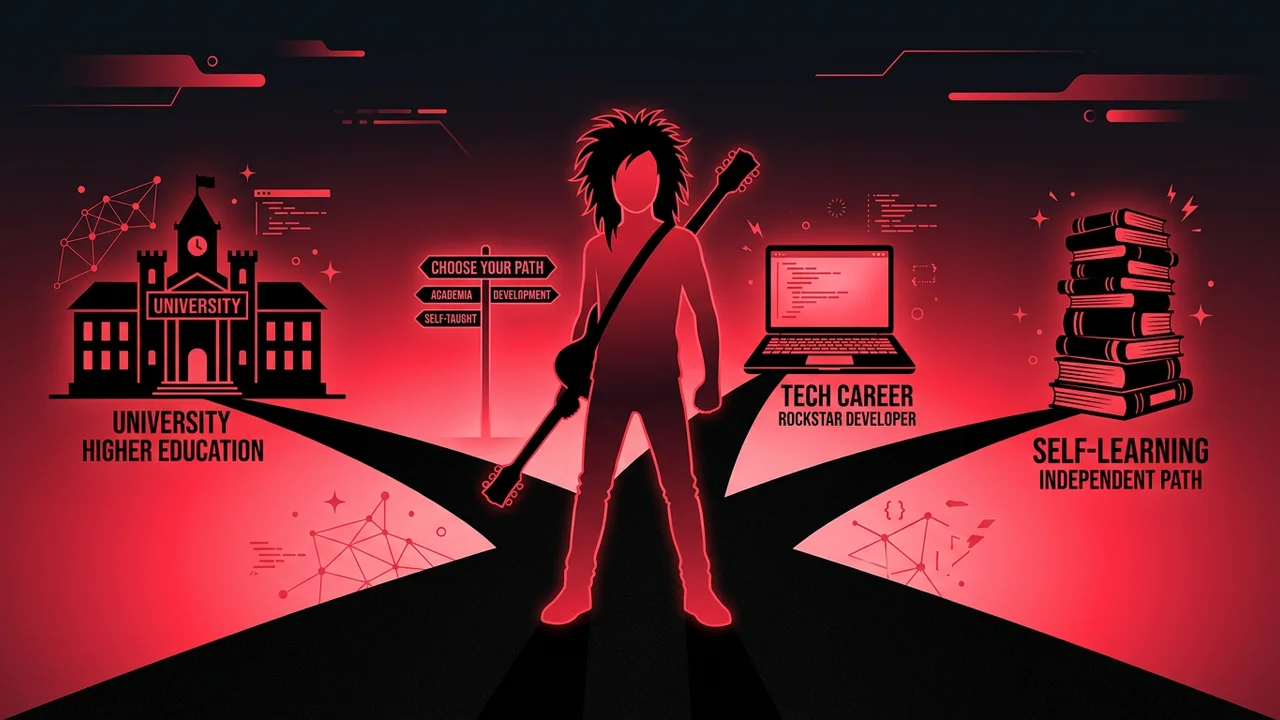
Most free programming course lists are just bookmarks. They throw Coursera, freeCodeCamp, Codecademy, YouTube, and documentation into one pile and leave beginners with the hardest question unanswered: what should I study first, what can I skip, and what should I build to prove I learned it?
This resource is built differently. It is a curated curriculum map for becoming employable as a developer without wasting months on random tutorials. It combines free courses, official documentation, project checkpoints, and job-market signals so you can choose a path instead of collecting tabs.
This page takes the best part of platforms like freeCodeCamp, Coursera, and Codecademy, the structured free learning, and adds what most of them do not: a sequencing system, project outcomes, and hiring relevance.
1. Key Findings
- Software developer employment is projected to grow 15% from 2024 to 2034, with about 129,200 openings per year (BLS Occupational Outlook Handbook, 2025).
- The broader computer and IT category is projected to produce about 317,700 openings per year from 2024 to 2034 (BLS Occupational Outlook Handbook, 2025).
- Python adoption rose by 7 percentage points from 2024 to 2025, and FastAPI rose by 5 percentage points in web frameworks (Stack Overflow Developer Survey, 2025).
- Docker usage jumped by 17 percentage points from 2024 to 2025, making deployment literacy part of the modern beginner roadmap (Stack Overflow Developer Survey, 2025).
The takeaway: the market does not need another random list of links. It needs a free curriculum that teaches the right skills in the right order and ties each learning block to proof-of-work projects.
2. The Free Programming Roadmap: Study in This Order
If you are starting from zero, do not begin with frameworks. Start with the minimum complete stack: web foundations, one programming language, Git, command line, data, APIs, testing, deployment, and a portfolio project that proves you can ship.
This order matters because it compounds. A beginner who knows HTML, CSS, JavaScript, Git, one backend language, APIs, testing, and deployment can build complete small products. A beginner who jumps straight into a framework often cannot explain what broke when the framework hides the underlying web platform.
3. Best Free Programming Courses and Resources by Skill
Use this section as the actual directory. The recommended path is to choose one primary resource per skill, finish the projects, then use the alternates only when you need another explanation.
Web Foundations
- MDN Learn Web Development: best free foundation for how the web actually works.
- freeCodeCamp Responsive Web Design: best interactive beginner track.
- The Odin Project Foundations: best project-oriented web curriculum.
JavaScript
- javascript.info: best deep free JavaScript textbook.
- MDN JavaScript Guide: best canonical reference.
- freeCodeCamp JavaScript Algorithms and Data Structures: best practice-heavy track.
Python
- The Python Tutorial: best official introduction.
- Automate the Boring Stuff with Python: best practical beginner book.
- CS50's Introduction to Programming with Python: best structured university-style Python course.
Computer Science Fundamentals
- CS50x: best free broad CS introduction.
- Teach Yourself Computer Science: best roadmap for deeper CS foundations.
- Open Source Society University Computer Science: best full self-study degree-style path.
Git, Command Line, and Developer Workflow
- Pro Git: best free Git book.
- GitHub Skills: best hands-on GitHub practice.
- The Missing Semester of Your CS Education: best command line and tooling course.
Data, SQL, and APIs
- SQLBolt: best beginner SQL practice.
- PostgreSQL Tutorial: best official relational database introduction.
- MDN Fetch API: best browser API reference for beginners.
Testing, Debugging, and Deployment
- Jest Getting Started: best JavaScript unit-testing intro.
- Playwright Docs: best browser testing intro.
- Docker Get Started: best free containerization starting point.
4. Which Skills Should You Prioritize for Jobs?
Free is not enough. You also need to pick skills that map to hiring demand.
The Bureau of Labor Statistics projects software developer employment to grow 15% from 2024 to 2034, with about 129,200 openings per year (BLS Occupational Outlook Handbook, 2025). The broader computer and information technology group is projected to produce about 317,700 openings per year across roles (BLS Occupational Outlook Handbook, 2025). That makes programming education a rational long-term investment, but only if you learn beyond syntax.
The Stack Overflow 2025 Developer Survey gives a useful signal for what belongs in the modern roadmap. Python adoption rose by 7 percentage points from 2024 to 2025, FastAPI rose by 5 percentage points among web frameworks, and Docker usage rose by 17 percentage points (Stack Overflow Developer Survey, 2025). That is why this curriculum puts Python, APIs, and deployment literacy alongside JavaScript instead of treating them as optional extras.
Here is the practical prioritization:
- For front-end and full-stack roles: HTML, CSS, JavaScript, TypeScript, Git, APIs, testing, and deployment.
- For backend roles: Python or TypeScript, SQL, HTTP, APIs, Git, testing, Docker, and one cloud deployment path.
- For data-adjacent roles: Python, SQL, notebooks, data cleaning, visualization, APIs, and reproducible project writeups.
- For automation-heavy roles: Python, shell, Git, APIs, scraping ethics, scheduled jobs, logs, and documentation.
The mistake beginners make is trying to learn everything equally. The better move is to get employable depth in one lane, then add breadth only when projects demand it.
5. The Proof-of-Work Project Ladder
Courses teach inputs. Employers evaluate outputs. Every free course you take should produce a visible artifact.
A portfolio does not need dozens of projects. It needs a few projects that are finished enough to inspect. A tiny app with tests, deployment notes, a useful README, and a clear bug-fix history beats ten abandoned tutorial clones.
6. How to Use This Page Without Getting Stuck in Tutorial Mode
Pick one lane and one primary resource. If you are aiming for web development, start with MDN, freeCodeCamp, or The Odin Project. If you are aiming for automation or data-adjacent work, start with Python.org, Automate the Boring Stuff, and SQLBolt. If you want a deeper computer science foundation, add CS50x or OSSU after you can already build small projects.
Then follow this rule: for every course module, create or improve a project artifact. If a lesson teaches forms, add a form to your project. If a lesson teaches fetch, call an API. If a lesson teaches SQL joins, add a report view. If a lesson teaches testing, write tests for an existing feature.
Do not wait until you feel ready to build. Building is how you become ready.
7. Sources
Every external statistic cited in this resource comes from the following sources:
- Bureau of Labor Statistics Occupational Outlook Handbook: software developers and computer/information technology employment projections, 2025 release.
- Stack Overflow Developer Survey 2025: technology adoption notes for Python, FastAPI, and Docker.
- MDN Web Docs: web platform learning resources and references.
- freeCodeCamp: free curriculum pages and learn hub.
- Coursera: computer science course catalog page.
- Codecademy: HTML and JavaScript course pages.
- TripleTen: free Python course landing page.
- Harvard CS50: CS50x and CS50 Python course pages.
- Git, GitHub Skills, The Odin Project, SQLBolt, PostgreSQL, Docker, Playwright, and Jest documentation: free learning resource references.
8. Cite This Resource
You're welcome to cite this curriculum map or use it as a reference when recommending free programming courses. Please link back to the original source.
Suggested Citation:
"Free Programming Courses 2026: The Complete Curriculum Map." Rockstar Developer University, June 2026. https://rockstardeveloperuniversity.com/free-programming-courses/
HTML Embed:
<a href="https://rockstardeveloperuniversity.com/free-programming-courses/">Free Programming Courses 2026 - Rockstar Developer University</a>