
Quick summary
A president signed an order renaming AI to Super Intelligence. Here's what that actually changes for your job, and what the real data says about the hypothetical superintelligence it got named after.
On September 29, 2026, President Trump signed an executive order called "Inaugurating the Era of Super Intelligence," directing federal agencies to stop saying "Artificial Intelligence" and start saying "Super Intelligence," or SI, in official communications. Within days, programmers everywhere were typing a new search into Google: will super intelligence replace programmers?
I get why. If the government just rebranded the thing that's already reshaping your job, it's reasonable to wonder if something bigger just changed. It didn't, and I'll show you exactly why, then give you the honest answer for the much bigger question hiding underneath the search term: what happens to developers when, or if, something that actually deserves the word "super" shows up.
1. What the Executive Order Actually Says (and Doesn't)
Read the White House fact sheet and the order itself, and the mechanics are narrow. Executive departments and agencies are told to use "Super Intelligence" and "SI" instead of "Artificial Intelligence" and "AI" in non-statutory documents, reports, websites, and public communications. It does not touch existing regulations, contracts, grants, or statutes.
And here's the part almost nobody read past the headline: under the order, SI is given the exact same legal definition AI already had under 15 U.S.C. Section 9401(3), a machine-based system that makes predictions, recommendations, or decisions for a given set of human-defined objectives. The order didn't redefine the technology as something smarter than humans. It renamed the label on the box while the box stayed the same.
How the industry reacted
Reaction from the industry itself tells you how seriously to take the branding. Adam Kovacevich, CEO of the Chamber of Progress, told reporters "no one in the industry is about to start calling it superintelligence," comparing it to the government renaming the Gulf of Mexico.
Coverage from CNBC, the SF Standard, and Nextgov all landed on the same point: this is federal terminology policy, not a technical milestone. If you want the deeper breakdown of why the rename and the real concept keep getting confused, that's exactly what Super Intelligence vs AI covers.
If you want the career side of this, what the job is called now, what it takes, and how to get hired, start with my super intelligence engineer career guide.
2. Same Question, New Label: Will AI Replace Programmers?
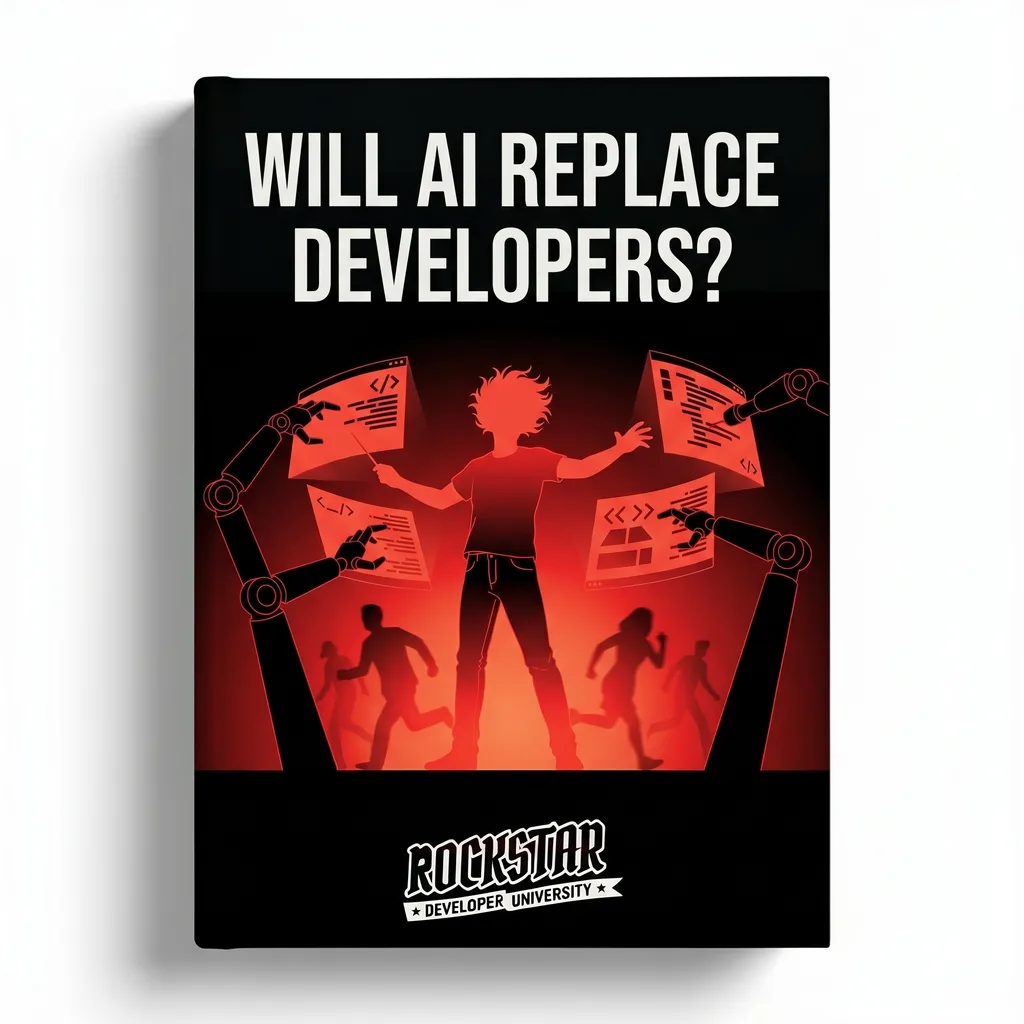
Strip away the new name and you're left with the question developers have been asking since 2023: will AI replace programmers? I already wrote the long, data-backed answer to that exact question in Will AI Replace Developers?, and nothing about a federal naming memo changes a single number in it.
It renamed the label on the box while the box stayed the same.
The short version, because it matters here too: the data is not a straight line. Some programming jobs are shrinking fast. Others are growing. The split is not random, and understanding which side you're on matters more than whatever word the government uses this month.
What the employment data actually shows
The U.S. Bureau of Labor Statistics shows overall programmer employment in the United States fell 27.5% between 2023 and 2025. That is a real, brutal number. But that same BLS data shows software developers, a distinct and broader category involving more design and architecture work, fell only 0.3% in the same stretch, basically flat.
A Federal Reserve research paper published in March 2026 backs this up from a different angle: aggregate coder employment decelerated sharply right after ChatGPT's introduction, and the slowdown traces to that specific occupational shock, not a general industry downturn. The jobs that disappeared were disproportionately the ones built around typing well-specified code into a file. The jobs built around judgment, architecture, and ambiguity mostly didn't.
3. Who's Actually Losing Jobs to AI Right Now
A Stanford Digital Economy Lab study found employment among software developers aged 22 to 25 fell nearly 20% between 2022 and 2025, while developers over 26 saw stable or growing employment. That is not a subtle gap.
The researchers' explanation is the same pattern showing up everywhere: AI is good at replacing textbook knowledge, the syntax and standard algorithms junior developers lean on, while experienced developers carry years of handling the messy, unexpected situations AI still struggles with.
What employers are actually doing
The hiring numbers tell the same story from the employer side.
- Overall postings. Software engineering job postings rose roughly 11% in early 2026 compared to the year before.
- Entry-level roles. Even so, entry-level roles for 22 to 25 year olds kept declining by nearly 20%.
- System-design demand. Demand for engineers over 30 with system-level design experience rose 6% to 12% over the same window.
- AI-fluency pay gap. The gap between AI-fluent and non-fluent developers widened fast: workers with real AI proficiency now command a 56% salary premium over peers without it, up sharply from a 25% premium not long before.
If you want the full statistical picture of who's being squeezed and who's thriving, Software Engineer Unemployment Statistics and Will AI Replace Jobs? The Statistics both go deeper than any single paragraph can here.
The rename didn't change the data: junior, narrowly-scoped coding jobs are shrinking while experienced engineers who can architect systems keep getting hired at a premium. The free Rockstar Engineer Blueprint is a 5-day course from John Sonmez on becoming the developer your industry knows by name, so you land on the right side of that split.
Get the Free Course4. What About Real Superintelligence, the Bostrom Kind?
Here's where I have to be fair to the search term, because "superintelligence" already meant something before a politician borrowed the word. Philosopher Nick Bostrom popularized it to describe a hypothetical future AI system that exceeds human intelligence across essentially every domain, not a chatbot with a new name tag.
That version doesn't exist yet. Nothing currently deployed, not GPT-5-class models, not Claude, not Gemini, qualifies. The gap between "very capable large language model" and "generally smarter than every human at everything" is enormous, and serious researchers disagree sharply on how far away it is, or whether current architectures get there at all.
Why this distinction matters
This distinction is not academic trivia. Stanford runs an actual graduate course called MS&E 338, "Aligning Superintelligence," taught by professor Benjamin Van Roy, built entirely around the premise that a true superintelligence, if one is ever built, might not act according to its operator's intent, and that figuring out how to prevent that is a serious open problem.
Senator Bernie Sanders introduced a bill called the Ban Artificial Superintelligence Act that defines the term the Bostrom way: AI that matches or surpasses human intelligence broadly, or that could disempower humanity. Policy researchers like Adam Thierer of the R Street Institute have specifically warned that the White House's rename "muddies the waters between tool AI and super intelligence," blurring exactly this distinction.
“Muddies the waters between tool AI and super intelligence.”
— Adam Thierer, R Street Institute
So if the honest question you're actually asking is "what happens to programmers if a Bostrom-style superintelligence gets built," the honest answer is: nobody credible claims to know, because nothing like that has been built, and every serious estimate of when it might be is a guess dressed up as a forecast.
5. Why the Demand for Software Keeps Growing Anyway
Every wave of automation in this industry's history was supposed to end programming as a profession.
- COBOL, 1959. Explicitly designed so business people could write their own programs without programmers.
- Visual Basic, 1990s. Visual Basic and fourth-generation languages were supposed to make coding obsolete.
- No-code tools. WordPress, Squarespace, and no-code tools like Bubble were each going to kill web development.
Every single one instead created more demand for developers, because making software easier to build doesn't shrink the backlog of software people want. It explodes it.
The BLS still projects software developer roles will grow 17% through 2033, well above the average for all occupations, and that projection already accounts for AI.
None of that means you can coast. The composition of the job is changing fast, and whether you benefit from that shift or get run over by it depends on what kind of developer you decide to become.
Whatever the government calls it this year, the developers who win are the ones directing AI, not competing with it. The free 5-day Rockstar Engineer Blueprint shows you how to become known for that kind of work, so the best roles and offers come looking for you instead of the other way around.
Get the Free Course6. What You Should Actually Do About It
Stop tracking renames and start tracking your own position on the ladder. Move up the abstraction level: system design, architecture trade-offs, and the judgment calls AI still can't make reliably are worth more every year, not less.
Get good at directing AI instead of competing with it, because the developers commanding that 56% pay premium are the ones who treat AI tools as an advantage, not a threat. And get known.
When a hiring manager already recognizes your name from work you've shipped publicly, you stop competing with the flood of applicants chasing the same postings. That exact shift from employee to the engineer companies actively chase, specifically around AI work, is what the AI engineer career path is built around, and it's the fastest answer to a government rename that most developers will ever need.
Explore more on